Clowning as Transformative Practice
by Barnabyking on Nov.06, 2009
under Announcements
How does clowning (in particular the practice of CWB) affect people: their audiences around the world, both adult and children, and all the people who participate, including the clowns themselves? Follow this blog for a day-by-day documentation of a CWB project in Colombia, as I ask this question and hopefully get some answers! The blog is updated daily, with the newest entry always at the top of the section below.
Research by Barnaby King, PhD Candidate Performance Studies
From Group to Individual – collective and diverse responses
This morning, we arrive back in the same auditorium where we performed yesterday, and again walk into darkness. Some older students are in the middle of a PowerPoint presentation about domestic violence in Colombia. Images flash up as we are trying to get ready: traumatized faces, abused bodies, earnest texts about the country’s social problems. The huge screen dominates the semi-circular lecture hall, and prevents us from passing across the stage into our dressing room area, so we change and stretch on the bare brick floors of the aisles, wondering when the class will finish. There are lines of children shouting and jostling outside the door.
There are shards of broken glass on the narrow steps that lead down from the stage level into the small corridor space that serves as our dressing room. Among stacks of chairs and odd bits of junk we get ready, in almost total silence, listening to the sounds of excited crowds flowing into the auditorium above us. There is something slightly different and tense in the atmosphere today. These are our last two performances of the trip. Our tiredness is showing. The beginning of this week was energetic and focused. Today we are using the reserve banks again. But also there is a sense of an end approaching and the reflectiveness that that brings. What have we achieved here? How will this continue? What will we be doing in a week from now? Some energy starts to build between us as we send claps across the circle (a warm-up we are in the habit of doing just before a show). To work well (that is, to flow smoothly and rapidly) one must concentrate like a hawk in this game. Anyone may pass you a clap at any time, and you have to be constantly aware of what is happening in all directions. I find that I can sometimes get into a state where I am not really looking at anyone, but I have total peripheral awareness and readiness. The clap passes through me, I receive it and pass it on without conscious thought. I am just a cog in a well-oiled machine, and my fellow performers are other cogs. But at other times, I stutter and hesitate. I catch a movement out of the corner of my eye but it takes while to register. If one person is out the whole group loses its flow. The rhythm is jerky and uneven, speeding up, slowing down. We look anxiously into each other’s eyes for inspiration, intentionally pushing to get that flow back. The game oscillates between these poles of fluid gliding and tense pushing.
The children keep coming, or maybe they are all here now. There is a lot of muffled noise, someone is talking through a microphone, the children are clapping and chanting. Then some ceremonial music starts and they sing what sounds like a national anthem but is in fact the school song, whose words are printed up on big banners in the auditorium. I crunch my way up the stairs to take a peak above, and see around the curtain that there are children on the stage dancing. The auditorium is only half full, so I assume this is all delay tactics while we wait for some late group. I go back downstairs and tell the others we are obviously not starting for a while, and what had been a last minute energy warm-up dissolves into a group sing-song while we wait, playing songs we know but improvising new words. This is a very different kind of warm-up: more about building the collective sense of pleasure and creativity, than about priming our attention or our rhythm. It is more emotionally driven than cognitively or physically.
Although this is not a conscious choice on our part, I feel in retrospect that these two kinds of warm-up we have been doing, the technical and the emotional, relate to two kinds of clowning or clown routines that we have in the show. In the technical kind, there is usually a simple objective that must be achieved (to get the newspaper, for example) and an implied contest or conflict between two people. All the moves are about achieving that in way that will get laughs at every well-timed beat and look to the audience. It is dependent not so much on feeling anything as achieving a set of choreographed moves that “show” a clear relationship and narrative. The other kind of pieces, which I will call “emotional” are more improvised, less choreographed, and more playful in the sense that they come from a common emotional source but they are different each time. They depend more on the synthetic interactions of the clowns in the moment, responding to each other and the audience to produce the action most suited to the context. In climbing up onto the trunk at the start of the motorbike piece, there is no set choreography but rather a collective game of climbing that tells a slightly different story each time. As I do this piece I feel its emotional source, the need to get up and see over the heads of the audience, rather than technical objective of standing on a trunk, which originated in the improvisation that produced the piece in the first place. So maybe being involved in the creative genesis of a routine contributes to this feeling, as much as the objective reality of it. Perhaps if I had created the newspaper routine I would feel differently about it, and that would make the difference between a technical routine and an emotional “clown turn.” One is a simple repetition of modelled moves that produces an effect that depends on the successful execution of the moves. The other is a recreation of an experience we have had, which felt like an originating, creative experience. In the recreation there is not just reproduction but an engaged re-living.
Whatever the difference in our own experience, there is definitely a difference in the audience’s response. The technical routines are punctuated rhythmically by audience laughter. When it is flowing we seem to be in symbiotic connection with the audience. As each of our moves is answered by a wave of laughter, that laughter guides the timing of the next move, which hopefully produces an even bigger wave that once again we ride to produce a third. There is an addictive quality to this riding of the waves of laughter, partly a feeling of being that cog in the machine, but also a sense of pleasure and pride in one’s technical ability to command such a response. It is both an active and passive experience. Likewise, when it is not going well, and the laughs are not coming, it is frustrating and difficult to escape, as the harder one pushes the more stilted and jerky the timing seems to become. Instead of being locked together in symbiotic action/laughter/action chains, the audience is watching performers pushing a boulder up a hill, just wishing they would let it go and see it roll to the bottom.
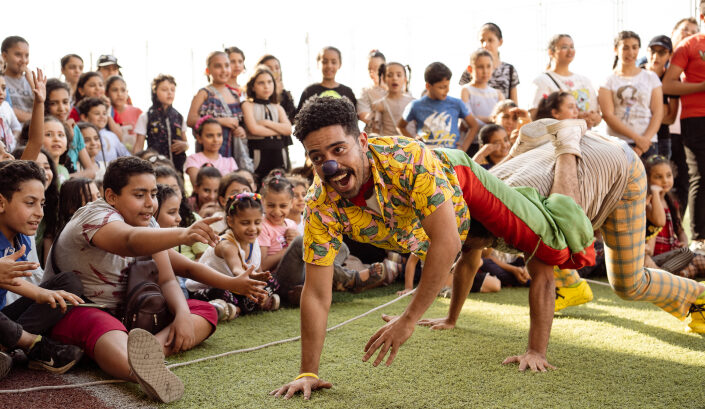
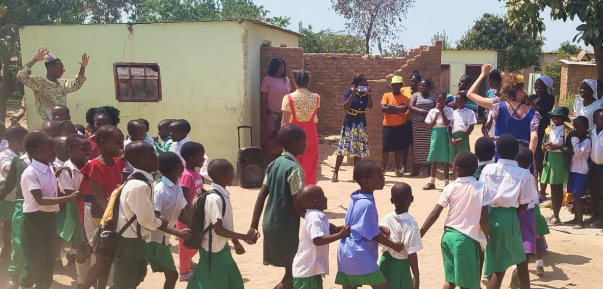
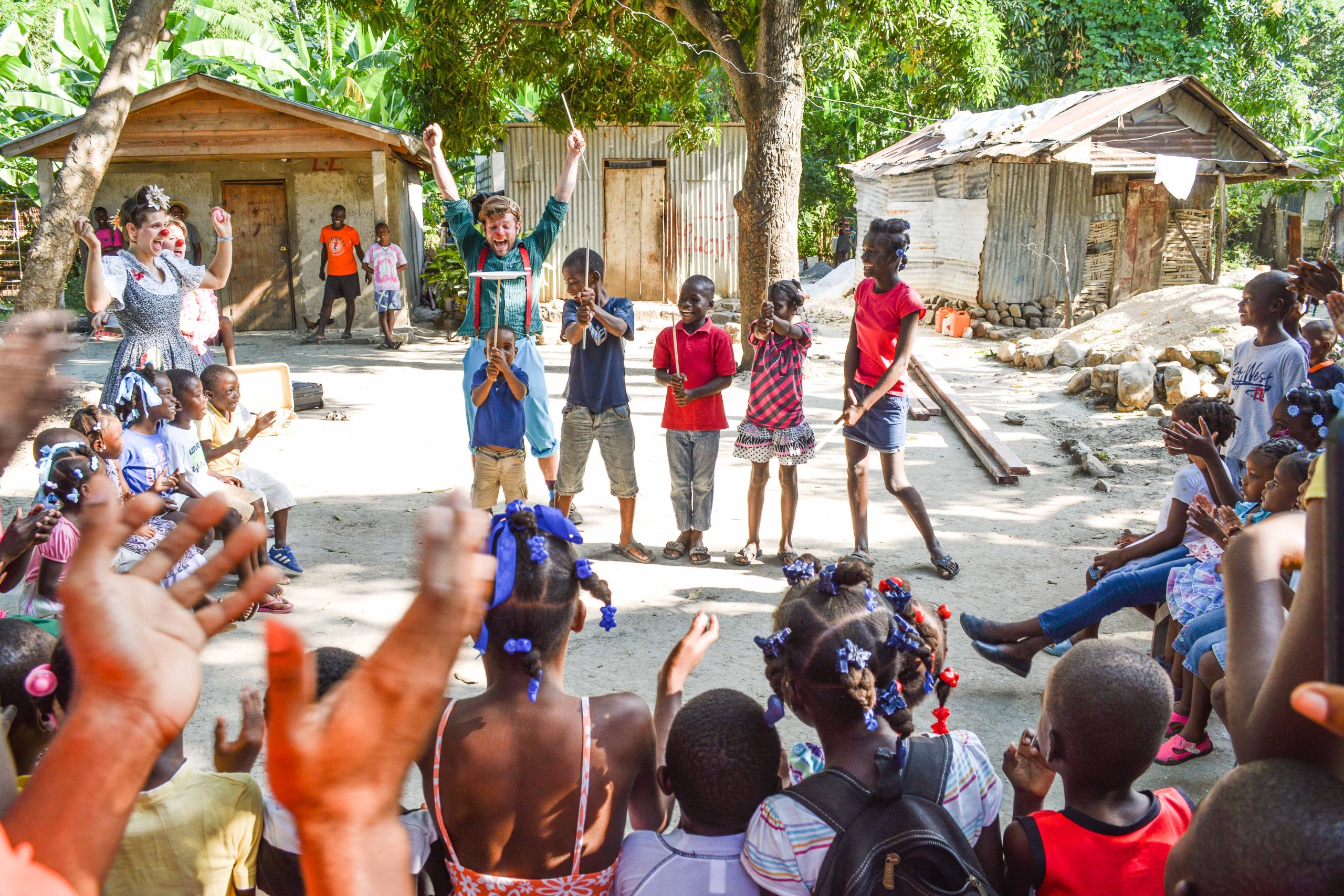
The “emotional” pieces, by contrast, do not necessarily produce laughter, though sometimes they may. It doesn’t feel like a problem if they don’t, however. In fact they seem to produce a range of responses, and maybe that is their strength. My own observations and those Alain, the photographer, as well as the evidence of his pictures, suggests that at the same moment the audience becomes fragmented and individuated, each person having their own private experience which is expressed through their facial gestures. As we climb up the trunk, or turn the trunk into a motorbike, there could be one person looking afraid, one shocked, one awed, one amused, one confused, all sitting alongside one another. I think the photographs do better justice to the subtleties of these expression than words can, but even the pictures cannot get inside people’s heads, and in the end they just provide a evidential trace from which we must deduce some impenetrable and always subjective experience. I think that what we see happening is that in these more emotionally driven pieces in which we feel creative ownership, the audience is released from the demand to respond as one, and instead enter into a creative process with us, mediating the physical action through their own emotional and remembered universes. In turn this produces something that is new, not just for us, but for each member of the audience.
So the moments of fewest laughs could be the most individually transformational moments. However, this does not discount the importance of the laughter in the technical routines. In fact I might suggest that each reinforces the other, that the emotional pieces constitute an intervention into the flow of the technical routines, a space of slow reflection when we come back into our personal worlds. And the laughter produced by the technical routines is a necessary counterpoint and release from the intense emotional and cognitive activity of the other, more active parts. It is a break. It is “recocha”: a spontaneous and collective burst of anarchic energy, a limited period of meaningless fun and raucous laughter that does not depend on thoughtful reflection, but rather on automated laughter response and the pleasure of being part of the crowd’s collective being.
We are kept waiting a long time before finally we are called to grope our way up the stairs and onto the stage. As we parade up and down the aisles, the over-excited children are cheering and reaching out to touch us. This is the most enthusiastic welcome we have had, and it continues throughout the show. They are with us every step of the way, laughing and feeling along with us. The us-them barrier seems hazy, if not invisible. They are on top of us, on the stage with us, and we are following and leading them at the same time. They burst out in spontaneous applause at frequent intervals through the show, seemingly just at the sheer pleasure of a moment. In shows like this one, the two kinds of routines starts to blur, and we seem to be doing both at the same time. The technical routines feel creative and emotionally driven, rather than an empty series of moves. The emotional pieces feel innately choreographed and naturally funny with plenty of laughs resulting from spontaneous “gags.” In some shows the two kinds of routine feel quite distinct, however. I see this as a way we could build a kind of analytical frame for specific performances, or a way to talk about the character of particular performances, based on the distinctions between these two kinds of routine, and the degree to which those distinctions break down or cross over. A routine is not innately technical or emotional, but could be both, perhaps weighted one way or the other, and could also differ according to the performance conditions, audience, performers’ state of being.
In contrast to the performances I described this time last week in the Polytechnic, where a “perfect storm” of conditions conspired to make the performance seem flat and disconnected, our final two performances feel vital and lively. The space is intimate and resonant, the audience is relaxed and energetic, we are imbued with the emotional energy of the “finale” performances. The second, and final, show builds on the first and is perhaps the best we have had in terms of sheer pleasure and flow. When we come back down into the cavern beneath the stage we all hug each other, marking the end of the tour. I am content, but also exhausted and feeling a little empty, like I have left my soul up there on the stage. The sounds of the children above us slowly recedes and we change and pack up our things, eventually emerging into the empty space. When I have had a good experience in a space, I often have a ritual of blowing a blessing into the space as I leave, just to say thank you for this coalescence of events that feels like a gift from the clown gods. They have been bountiful in this theatre, where we have completed our final five performances over two days.
Una Montaña Rusa de Verdad (A Real Rollercoaster Ride)
I am flying through the streets of Ciudad Bolivar in a taxi with Wilmar. We have just met with children and teachers at the Gimnasio Sabio Caldas where we performed last week, had lunch with them, and now we are rushing to get back to the Colegio Federacion Suiza in time for our third performance. The driver weaves in and out of the slow moving lines of buses, churning out plumes of black smoke. We have come all the way down one huge winding hill, out of the neighbourhood of Potosi and must now cross the river before heading up into Vista Hermosa on the neighbouring hill. I stare out at the bewildering terrain of ridges and slopes stacked up with identical tin-roofed houses, worried about our lateness and fact we are keeping everyone waiting, but glad that I have someone with me who knows the way.
Ciudad Bolivar, although technically a suburb of Bogota, is really a huge city in itself, made up of over 300 neighbourhoods. It is built on a series of hills overlooking the rest of Bogotá, stretching higher and higher into the foothills of the cordillera. The majority of the city began as temporary shacks built on “invaded” land, meaning that it was not owned or bought but just built on by people who could not afford proper housing. What started as an illegal “shanty town” has gradually become legalized and brought within the borders of the municipality. But it still retains the feel of a slum, when compared to the cosmopolitan atmosphere of Bogota. There is an air of unpredictability and chaotic movement.
We come to a narrow iron bridge, and at the other end I see two buses about to get on it also. Our driver steps on the gas and speeds onto the bridge, quickly covering the length of it and meeting the first bus almost at the other end. But the buses have come too far towards the bridge for us to be able to proceed off it and past them. We are bumper to bumper with the front bus, unable to pass, and the second bus is right behind the first. The driver simply stops and sits, doing nothing, unwilling to back all the way along the bridge. The bus likewise sits in front of us, refusing to move. For several minutes the standoff continues, with neither party doing anything at all. Finally someone gets off the first bus and frantically waves at the bus behind to reverse, which it does, allowing the front bus to back up also. As we come off the bridge and pass the bus, the two drivers exchange a steely glare.
Thanks to our overrun meeting at the Gimnasio Sabias Caldas, the long wait for a taxi, and now this pointless delay, we are certain we are going to arrive very late. We continue to wind up and up the hill, bumping our way through the potholes and overtaking more buses. Puerto Rican reggaeton blares from the taxi’s overpowered speakers: “Esta es la noche de sexo…voy a cumplir todas sus fantasias.” Although we are still in Ciudad Bolivar, this neighbourhood feels different: there is more activity on the streets and more trash on the sidewalks. We finally screech to a halt outside the school and, after a brief delay to find change from a small shop to pay the taxi driver, we run through the gates and up several flights of steps and through the entrance to the auditorium, expecting to find the audience in place and the clowns waiting for us to begin. Instead we find ourselves blinking to see through the darkness. All is peace and quiet. Our colleagues are lying half asleep on benches. It turns out the electricity has failed, and the performance has been delayed while we wait for someone to effect a reconnection.
This is a pretty typical story for me in Colombia. I am often running late and usually stressed because I think I am keeping people waiting. Often it turns out that they are not waiting, because some other unforeseen event has intervened, or they are simply running late themselves. My stress is often needless, but I have not yet quite learned to adjust my rhythm. People make fun of my British punctuality, which does not necessarily mean I am always on time, only that I expect to be and expect others to be. The same thing happened on our trip to the Gimnasio before lunch. Due to rush-hour traffic the whole day started late, and we had to do two back-to-back performances to huge and enthusiastic audiences, which left us drained. After the second, Wilmar and I ran out to catch a cab and bumped and swerved our way down the hill of Vista Hermosa and up the hill into Potosi. I had organized this lunchtime interviews with the principal of Sabio Caldas because I thought that the two schools – both being in Ciudad Bolivar – would be close and convenient to travel between. I was wrong, for reasons I explained above.
We arrived at Sabio Caldas twenty minutes behind the scheduled meeting, but nobody was waiting for us, and truth be told they were not even ready for us. We were asked to wait in the administration offices. We watched children and staff coming and going in the big open-plan area, where, like a lot of large institutional architecture in Colombia, the whole shape of the space, including the partitions, the reception counter, and the floors, is moulded in one continuous form of bare red brick.
Ember, the principle, strides out to meet us. He is a suave, confident but practical and down-to-earth guy, the sort of person who looks you in the eye, listens, asks pertinent questions, and commands instant respect, even though he looks like he can’t be more than 40. He greets us warmly. He is busy running a huge school, yet he makes us feel that we are important to him and that he wants to give us his time. But first we are taken to a meeting room where 15 students have been gathered and, seated in a circle, we begin a semi-formal discussion. While some are self-conscious and reluctant to participate much, most are attentive and responsive. A few are particularly articulate and enthusiastic. We move through many topics, starting with the question of What did you particularly enjoy about the show? and then allowing the conversation to flow depending on what was said. In a kind of schematized form, I have transcribed parts and summarize other parts of what they said.
When asked what they particularly enjoyed, the older students (13-17) tended to respond generally, referring to aspects of technique and approach, while the younger students (9-12) referred more to specific moments that they liked. The technical aspects mentioned were costumes, use of music and sound effects, the simplicity of story-telling with minimal scenography, the use of physical as opposed to verbal language, the intrusion of the clowns into the audience’s space, and the use of “recocha” (fun party-like atmosphere). The older students were able to make a clear distinction between our “style” of clowning and the “style” they were used to seeing in Colombia, normally found in children’s parties or in the circus. In particular they said that we were “acting” as opposed to just talking, which the Colombian clowns do a lot, and that we used physical techniques such as mimicry to capture the audience’s attention. Our costumes were also very different: the Colombian clowns wear mask-like makeup and big “scary” wigs that often frightens young children.
This sense that they were experiencing something “new” went far beyond just a new kind of clowning. Many said that they had never seen anything like this before. They never have any kind of performance in the school, and the theatre they had seen in other places was nothing like this. It included multicultural aspects, the music in particular, that were “new” to them, and some said that they felt the laughter brought by the clowns allowed them to see reality in a “new” light, or from a “new” perspective, often a positive one.
In a discussion about the kinds of emotions and feelings the show created, there was repeated reference to the fact that it provided relaxation from stress and the pressure to achieve in school. Most of the emotions were classed as “positive” in that they helped to remove one from the one’s problems, leaving behind the daily routine and the sadness that people feel related to their own lives. Even the potentially negative or sad moments in the show, like the conflict and the crying, was turned into something funny that became captivating for the audience. One 18-year-old male student, who was particularly vocal, said that in the story you became conscious of your own problems but that it is made you able to see the funny side of them. Thus “negative” feelings don’t always have to be bad, but can even be transformed into something positive.
There is a kind of contradiction here: on the one hand the clowning seems to take people out of their daily routine problems, and thus de-stresses them, while on the other hand it reflects their problems but shows them in a new light. But perhaps it needn’t be either/or but both/and: maybe the process involves a double-consciousness in which both effects of erasure and re-membering are in play. Daily reality is neither truly forgotten, nor merely brought to mind. The reference to “recocha” is significant here. The source word is difficult to trace, but seems to be a Colombianism that comes from the word “cochino” (pig) and possibly refers to the sexual act of a pig. In everyday use it has come to mean a spontaneously arising limited period of relaxation of the normal rules, disorder, disturbance, commotion, racket, boisterous fun, associated with jokes, raucous laughter, meaningless fun and indiscipline. Although it implies a shift of energy from everyday mundanity, however, it does not entail a conscious rejection or resistance to authority, but often happens within closed and formal situations, like the office or the classroom, where for some reason there is a sudden relaxation of the rules and everyone takes a break from work. In previous interviews on the effects of clowning in hospitals in Colombia I have heard the word used to describe the effect produced when the clowns enter the workplace and for a few minutes transform the strict atmosphere into a festive party one. “Recocha” is temporary, and soon things return to normal, but the hospital staff say that when they return to work they do so with a renewed sense of purpose and drive, as if the temporary disorder has relieved some tension or cleansed the palate. During the period of “recocha,” normality is abandoned, but not forgotten, and once it returns things all seems a little different. So within the concept of ‘”recocha” there is this same double vision the students have articulated: temporary forgetting (that is not really forgetting) of reality and transformation of the reality that was never really forgotten. “Recocha,” it is pointed out by one of the students, is something clowns can bring that ordinary theatre normally could not, as theatre has strict limits, while clowns have “no limits.”
But as well as being a kind of escapism, does the show also communicate a specific message for the these young people about their own reality? Does it seem to encourage certain social values or behaviours? Is there an implied moral? I must admit that this part of the discussion with the students was somewhat forced. They did not volunteer this information without me asking the leading question, Do you remember any moments in the show which relate to specific real-life problems you might have? There were many responses: the newspaper scene was about envy; La Llorona’s story was about rejection; the motorbike scene was about selfishness; Gwen’s behaviour towards the men was seen as a kind of showing off, or attention seeking. In each case the “real” issue referenced was seen as negative: envy, rejection, selfishness, attention seeking. When pushed, the students saw this is a kind of moral tale, in which the clowns portray common everyday vices that should be avoided. For example, Gwen’s showing-off is common, but the students tell me that it is a kind of inauthenticity that is not necessary, that it is better just to be oneself and act “naturally” than to pretend to be something you are not. They condemn the action as a deceitful strategy. The moral is that we can leave behind such petty ways and be more honest with each other.
La Llorona’s marriage was another “real life” reference, but this time a seemingly positive one. But the students were sceptical about this. Is it really the happy ending it appears to be? People change, husbands and wives do not always live happily ever after. Many students, no doubt influenced by their own experience of broken marriages and paternal abandonment, doubted that the marriage was necessarily a resolution to La Llorona’s problems. Their responses in both cases implied a critique of the clowns’ behaviour in terms of their daily reality. The clowns’ negative behaviours reflect how things actually are, implying how they should be. But when they achieve something superficially good, this is seen as unrealistic and doomed to failure.
I am impressed by the insights these young people had into the show, and am curious to know more about the school, to see if the educational context may encourage such perceptions. I also don’t know if they students would have had these realizations without the further discussion provided by the interview. Does the show, by itself, produce this kind of reflection? We go straight from this interview to meet with Ember once again and a group of teachers join us for lunch. When I raise this issue, they suggest that such a moment of reflection was something missing, and it seemed that even they had not thought about the social relevance of the experience, but were more focused on the immediate behavioural benefits: even very hyperactive and troublesome children were captivated and for a short while were calm and tranquil. Even older teenagers, who normally would say they don’t like clowns, were engaged and enjoying it. Ember mentions his favorite clowns (Slava and the Dimitri Brothers, whom he has seen at the IberoAmerican festival of theatre in Bogota) and likens the innocence, simplicity, beauty and sweetness of their work to ours. He has an appreciation of our style as something very different from the typical Colombian clown, something more European and perhaps therefore of a higher social status.
This privileging of European (or non-Latin American) culture pervades much of what Ember and his teachers say. Not only are European clowns better, but European (in particular British) society does not have the endemic problem of dishonesty that exists here, according to him. This is the deepest source of many of Colombia’s problems, apparently. His “theory” is that the children in the his school lack creativity because they are brought up from an early age being told that their opinions do not count, and that in general it is better to keep quiet that to say what you really think. The value system encourages silence or outright lying as preferable to honesty, because one learns that truthfulness does not pay. If one is honest and owns up to a mistake, even if it was accidental, you will get hit anyway. So it is better to lie or run away, or try to get away with something than to reveal it. Associated with this, is the general aversion to rocking the boat, or being controversial. Agreement and compliance are seen as superior tactics to truthful expression. While in some countries (e.g. Britain) one can have an argument and at the end of the day still be friends, this is not considered possible here. Friendship must be expressed through agreement. To criticize someone’s idea is to criticize them personally.
This rather negative view of his own culture in relation to a supposedly more open one elsewhere forms the basis of much of the school’s philosophy, which is to encourage children to be open, emotional, to say what they are thinking, to propose ideas, solutions. But it is difficult, he tells me, since children are always being told their opinions have no value. So while he admits it is “just a theory”, it is clearly a deeply held belief that informs the pedagogic practice of the school. We are experts in hiding the truth, and we are working to counter that problem.
The relationship between Ember’s ideas of truthfulness and deceit are fascinating when put into relation with what the students have told me, and points to the value of such follow-up conversations. I was surprised at the facility the children had of placing the content of the show into a social context, but in the context of Ember’s discourse of authenticity, which seems to pervade school policy, reveals how the students interpretation of the play was probably mediated by exactly this kind of discourse. Self-expression and “being oneself” are encouraged in the school, so it seems natural that they should critique La Llorona’s flirtatious showing-off as inauthentic. Likewise, the negative and critical stance of the students towards behaviours that are seen as common social problems in Colombia (envy, selfishness etc,) seems to reflect Ember’s own negative feelings about his home culture. All this seems to support the idea that the show is not interpreted in a vacuum of free thought, but is shaped by the institutional context of learning and example within which the young people are located.
There is a further twist to this tale: the context of the interview itself (rather like a classroom setting) encourages particular kinds of engrained responses, not necessarily those produced just by the experience of the performance, but by an additional layer of situational pressure. If, as Ember suggests, Colombian society produces subjects who are experts in providing the diplomatically “appropriate” response, what does that say about the responses I received from the children, and how might these be different from more “authentic” or immediate responses to the show itself? It seems that this after-show interview with students has revealed (or maybe produced) some interesting reflections on themselves. Ember suggests that some follow-up material for teachers would be a really useful addition to the project, to encourage this kind of learning opportunity. Obviously, as a teacher who wants to expand the possibilities for his students, it is natural that he should focus on this social learning function. In particular he mentions the benefits of realising that one’s problems are unique to oneself, the knowledge that I am not the only one suffering (a self-indulgent problem often associated with teenagers). Clowns are good at this, because they have many problems themselves. By reflecting the problems of the audience back at them, such problems can be generalized, shared, and their weight thus dissipated. Having follow-up discussions may, as Ember suggests, an important way to bring these issues to the surface, to make them explicit. But is that in keeping with the intention of CWB or clowning in general? One way of looking at this evidence is that an initial emotional response is converted or trained into a cognitive response by means of a verbal conversation that is not part of the performance. The emotional responses vary from relatively unified group responses to more individual and distinct reactions. Also, some level of cognitive response probably occurs as a direct reaction to the show, but it is likely that the conversation afterwards helps to develop and articulate that response more clearly. But, as we have seen, the cognitive response is colored by some aspects of socialization such as educational context, diplomacy etc., so it may not be a “truthful” version of what the students are thinking. I am a long way from understanding the complexities of this situation, and further study is required. Perhaps at this stage it is only possible to say that the choice of whether it is useful to do follow up activities, or provide materials for teachers to do so, depends on whether it is felt that there are more long-term benefits to be gained from a deepened a cognitive self-reflection on a largely emotional experience, or from allowing that emotional experience to stand alone. To abstract this another level, is it useful to talk about clowning and what clowning means, or is it a kind of experience whose impact is not reducible or expandable through a separate conversation? Laughter, happiness, temporary escapism, feelings of community: are these sufficient goals unto themselves? Or are we seeking to convert these visceral experiences into new conscious awarenesses as paths to change or action?
Clowning as antidote to conflict and aggression
The administrative offices of the Hogar San Mauricio are in a beautiful old Colombian house, set around a stone courtyard, and replete with antique furniture and squeaky wooden floors. We sit around in comfy armchairs drinking Blackberry fruit juice, coffee, and munching on cookies, watching out of the window as files of children walk across the grass to the covered basketball court, where they gradually fill up the banks of concrete steps along one of its lengths.
Christina, the director of this Hogar (home) is also a psychologist and she talks to us about the children before we go out there. A small number have parents, but have been removed due to severe maltreatment (sexual abuse, beating, neglect). Many more do not have parents at all. They have been abandoned or they have lost their parents to the conflict or natural disaster. More than ninety percent of the 170 children living here are available for adoption, but only around 20 children actually leave per year, mostly to families overseas in Europe or the United States. Family groups (i.e. brothers and sisters) are kept together as much as possible. When adopters are found who cannot accept the whole family group, however, they must be split up. Often the eldest of the group prefers to stay, because they are afraid of becoming the responsible parent figure for their younger siblings, as they have often been fulfilling this extremely onerous role already. Children are basically able to stay in the home as long as they want, but at age 21 they are encouraged to leave and establish their own lives outside the home. The problem is that they have spent so much of their lives within these walls, and living outside takes a huge acclimatization. Most of the children have “padrinos” (mentors), who take them out on trips, but this tends to be very intermittent, hence the great value placed on people coming in to visit the children and bringing a little bit of the outside world with them. More than anything else, Christine emphasizes that this is the greatest benefit of our presence.
The only relationships the children have are with each other. So when other people come in they want to know so much – where you come from, what you do – and this interaction relaxes them. They have been terribly maltreated and have had very harsh lives, and they put on a mask, and as you can see they are often extremely aggressive. When people come in to share with them it distracts them, it is a release for them and you can see their faces change.
The two shows and workshop today draw heavily on our energy reserves. In the basketball court the audience is so spread out that we have to work hard to include everyone at the far ends. What is more, this audience is a combination of very young ones and older teenage girls, who are initially sceptical. We gradually break through with some of them, but not in the way that we did yesterday with similar aged girls. What happens when the audience is mixed like this, as opposed to of a similar profile? During the hide-and-seek routine, young audiences have typically become very excited and vocal when the game becomes clear. They point and shout and try to alert Yuri and Gwen to Lucho’s hiding place. They continue with the game of not seeing him, but the routine develops beyond this simple premise, when Lucho starts to manipulate the other two into making signs of love toward each other, which both interpret as sincere. He tickles them, slaps them on the behind, and sends kisses from one to the other, each time hiding so that they both think it is the other that has done it. Responding to the trick seduction they go to kiss each other and instead both plant kisses on Lucho’s face, which he plants in between them at the last second. Older audiences have enjoyed the comedy of this routine, but the smaller children (4-7) don’t generally seem to follow the story beyond the simple chase and hiding set-up, but instead get caught up in yelling, chanting and pointing throughout the sequence. We have already observed how the show is different when the audiences have been younger or older. Both work, but the show takes on a different atmosphere and emphasis. In mixed audiences, however, the enthusiasm and chanting seems to have the effect of shutting out the older kids, diminishing their enjoyment or appreciation of the subtleties of the latter parts. The clear differentiation becomes muddied, we are not sure whom we are playing to. If today is typical we seem to end up playing more to the younger end in these situations, which probably has the effect of making the show seem “childish” to the older audience members, and therefore less interesting.
This is confirmed when I talk to some of the children after the show. As opposed to the teenage girls yesterday who focused on the romantic quest of La Llorona, they most enjoyed the magic and the turning of the volunteer into a clown. We have notice that this latter moment is working at its best when we are able to find someone who is normally a well-known figure of authority in the institution. There is a liberating pleasure for the children in seeing someone normally in positions above them being turned into a clown and made to look as stupid as we are. It turns out that the person Gwen picked on was an especially noted authoritarian. Christina, talking about the kinds of relationship the children have with adults and authority figures and how problematic this can be, confirms why this might be so impactful for the children:
When the children see a teacher dressed like a clown, they realize this is not just the authority figure that they see every day, but a human being like them. These children are so badly treated and so vulnerable that they think they are inferior to everyone in the world. They can’t love themselves and so they can’t love anyone else. But when they see other people who are willing to be laughed at and become like children themselves, it’s like someone is listening to their pain, and they feel like they are someone. It helps them to recognize themselves and see other people as humans not just as objects.
Christine brings up a type of impact I had not fully considered here: that the clowning might activate a kind of subjectivity that is lacking due to the experiences of the children. That is, it helps them become aware of themselves as agents with some freedom of choice as opposed to passive instruments of larger forces:
It’s a challenge to make the children feel like they’re not objects, because so many have been treated by their parent like objects. When their fathers come home drunk and maltreats them…the child becomes the object they use to vent their anger. If a family needs economic resources the child is used as an object to obtain money, put on the street to beg, or sell things. So he or she is often seen as an object, not as a subject, a person who needs to be listened to, and to express their emotions. They’re always being used. When they see a clown show, and they can laugh without being judged, and when they see adults who act like children with them, this allows them to identify with themselves as people.
What Christina tells us about the psychological state of the children concurs the experience we have in a workshop we have with them in the afternoon. We split the 60 kids into three groups of 20 and take them to separate spaces to work on basic games, acrobatics, and music. From the start it is obvious that trying to play even the simplest games is a huge challenge. Concentration is extremely dispersed, some are simply disinterested, and a surprising number of them fight, hit, and threaten each other at every opportunity. We are all taken aback by the aggression of so many of the children, who in the show had seemed relatively calm. This project has really focused on developing the show rather than workshops, so it is unsurprising that we do not have a well-planned tailored workshop, and unsurprising that we are caught off guard by a challenge that is quite different from performing a successful clown show or teaching workshops with more “socially adapted” kids. It was not a complete failure, though it felt disheartening. There are moments of calm concentration that feel like huge breakthroughs in the context. I manage to get them playing a game of showing different emotions in the body and face, which they then use to make each other laugh. For a few precious minutes it works and they enjoy it, until they start to crowd around too much. Pushing and jostling soon turns into shoving and hitting, and we have to move on. We all find that we lack the tools to deal with this behaviour, especially since it is prevalent in so many of them.
Although the workshops were of limited success, they had particular beneficial aspects. First, they were a way that the children got to interact more with us than usual. As Christine pointed out, any interaction with new people from outside is beneficial for them, since it creates bridges to the world they are so shut away from. But also it allows us to see them in a different light. As opposed to the usual impression we get of rows of delighted, happy children sitting through an hour-long show, we see them having to engage in more complex and less limited interactions. It is tempting to say that this is the “real” them as opposed to the “false” image we got from just seeing them during the show. But both are real and “authentic.” It is simply that in these conditions, with the focus on interactions with each other as opposed to with us, certain cyclical behavioural tendencies are more likely to be released. And for us this highlights the transformative impact of the show: that for a while it permits the children to have active interactions that do not entail conflict and aggression toward their own community, and to react playfully to a stimulus without feeling the pressure of judgment. Indeed, the main source of conflict during the show is the show itself, with its various depictions of physical competition. I ask Christine whether this can be beneficial for children whose aggression is such a problem:
Conflicts are a way for them to see their own reality differently. And the conflicts are resolved. For them conflicts do not have resolution. If they do something wrong they often have to pay for it, and it might be something they spend days trying to be pardoned for. When they laugh and see a way of resolving conflict in a more playful way, it allows them identity themselves as human beings. They have been so maltreated that sometimes they actually need to be maltreated, shouted at, just to feel normal. And that’s often why they act aggressively, trying to draw attention to themselves, and get into trouble. It’s a cycle. Often the parents of these children were themselves abused. And it goes on.
Experiences like this one help to break a cycle of violence, Christine suggests. She is specific about the ways in which clowning helps to achieve this: as we have seen already by bringing authority figures down to their level; by allowing them to see themselves as subjects rather than objects; but also by therapeutically allowing an expression of emotions that are normally kept hidden:
Clowning is the best therapy in the world. As a psychologist I see what you are doing as a kind of therapy that allows the children to take the mask is taken off, and to really be themselves through laughter and smiling. Diana for example was at one side with her face covered up and she didn’t want to be involved, but as soon as you entered she was suddenly brought out of herself and she was able to talk and be herself. It’s really a kind of therapy. It allows them to express their emotions without being judged, because there’s no one to judge them.
After the day’s work we are taken on a tour of the facility. We see classrooms where they learn cookery, computing, beauty treatment, and other vocational skills, we meet with the social workers who deal with the children’s everyday wellbeing, negotiate their integration, and organize the “padrino” trips. We see the long dormitory-style corridors lined with bunk beds where some of the younger children sleep, their sheet meticulously folded, tucked and then topped with rows of colourful toy animals. We visit the babies’ room (children up to 3 years of age) which is likewise lined with traditional cots. Here we spend ten cathartic minutes playing with the children, who want nothing more than to hold, cuddle, and play with us. Maybe these are the lucky ones, though it seems counter-intuitive to use that word in this context, taken from their families before the effects of maltreatment have taken hold as they have in older children. There is little sign of aggression from these children. Our interactions are loving and intimate, and seemingly “normal” for this age, except for perhaps a greater sense of neediness. But here, released from our own responsibility to be performers, workshop leaders, or advocates of CWB, we relax, play and enjoy the pleasurable emotions produced by the giving and receiving of love with “no strings attached.”
This tour brings to my attention how small a part we are playing in a huge system of care. The extent that we can benefit the children through clowning is entirely dependent on the structures already in place, a host of other creative activities, loving relationships, the daily provision of basic needs. When I ask Christina if our one-off visit can really be of much help, she reminds me that it is not a “one-off” visit but one among many such visits the children get. That is, they do not get clowns coming in every day, but there are many interventions, activities, visitors, each one contributing to an overall impact. This is an important point in my research, that needs to be remembered: while we may like to think of clowning as simply a detached and “free-wheeling” phenomenon that brings a carnival-like interruption of the everyday mundanity, it is also part of a system of institutional activity, and thus regulated and defined by these structures. Its effect is produced partly by conformity to these structures (working within and in line with the existing objectives and aims of the organizations), and partly by a differentiation from them (working against the prevailing norm, in order to provide contrast from that normality). This is of course the clown’s perpetual balancing act: the artful combination of recognizable conventions and anarchic inversions and redistributions or normality. Laughter is produced by both these aspects: familiarity and newness. And laughter is itself therapeutic, according to Christina:
Laughter heals the soul. It allows them just for one day to be themselves. To laugh without judgement. All of this helps them to heal their lives.
But for me, laughter is just one part of a set of effects produced by clowning, and in a way it is just one sign that it is working. When the children laugh at their teacher becoming a clown, the laughter is an emotional release, but this moment is also a symbolic inversion of normality that could linger in the memory and permit a transformation of the way the children see their world. The self-regulated order in the audience’s chanting and collective responses to the antics of clowns may produce a pleasurable release of emotion, but it also is a moment in which everyday relations of conflict and aggression are inverted and community is produced. There is something happening in the audience that is both familiar and new, the opening up of new vistas within a frame that seemed to be limited to a certain set of possibilities.
A New Planet and a New Perspective
This is a one-show day. I have arranged to visit a children’s home called Neuvo Planeta for children who have suffered extreme neglect and physical abuse. These children came to see the show on Friday in the huge auditorium of the Polytechnic, but they were seated near the back and I didn’t get much sense of their experience. Maria Paola, who is the “Mama” for over 250 children who live here, waves me in and while she is busy I wonder around looking for people to talk to. In a long dining room children crowd around curiously, physically clinging to my limbs, and asking questions. Some of them recognize me and remember exactly who I was in the show. Others know me from the show but can’t quite place which one of the clowns I was. I wade through the crowd to get to a seat, and then try to begin a conversation with them about the show and what they thought of it. My questions are simple and few: what did you think of the show? What were your favorite parts, how did it make you feel? The answers are equally simple. Mostly they list the moments they like: the motorbike, the juggling, la Llorana’s crying, the “scissors, paper, stone” game. But on occasion the conversation evolves from a simple listing of moments to a reconstruction of a particular moment or sequence of events in more detail. I would help this by interjecting reminders, but on the whole the conversation would bounce back and forth between them without much intervention from me:
“I like the motorbike part.”
“Yes, you know, when you were doing….” (here, the speaker physically recreated the movements of the motorbike skidding around corners).
“And then you three jumped off and left the girl on her own, crying.”
Several others here pretend to be Gwen, trying to start the motorbike, failing, and then crying. They all laugh.
This sliding between retelling and recreating happens several times, as the children I am with change over. While many children come and go, and some are much more interested in finding out about me than they are in answering the strange questions I am putting to them, there are a few who stick with me for the whole half hour, and seem to be very keen to talk about the show. One of them, Michael, remembers much more detail than I would expect. He is evidently delighted by his own memories, and relives them through his whole body as well as his face. He follows me and comes in to the office of Maria Paola later while we talk, and pays attention to our whole conversation. I ask her what the impact is of this kind of activity for the children. She answers me:
The philosophy we have here is that what heals the maltreatment of the children and the loneliness they have had in their lives is love and happiness. All activities of creativity and play help to bring them happiness, and help them be better human beings. So moments like the one you created are very important, give them a change to forget for a moment their stories, and they are able to sit in the play and enjoy it. They were very happy that night. Later they were “performing,” recreating what they saw. They slept very well. So it’s very healing
I ask what she thinks about the more tragic or violent moments of the show. How does this help them to forget their problems?
Most of the conflicts in the show were resolved. For example with the newspaper, the conflict was resolved by sharing it. So the message is that you can share. There is always a loving solution to the conflicts. It shows then that there are alternatives, different ways that a conflict or a difficult situation can end. When people laugh at something bad that happens, that is healing, when one is able to laugh at the problems or the sad situation that one has, it’s healing. When you’re removed or hit and you can make a joke out of that, it heals, it brings you out of the sadness. Also, it is more powerful than the words we use in the home because it provides a real example. You can tell a child to be honest, be honest, but then he keeps stealing and it makes no difference. But when he sees it on the stage and he laughs at it, it really stays inside and he knows that it’s a possibility, to move out of the conflict in a different way. I feel that this is very important. You don’t know what seeds are being planted, when you make them laugh, because there are some that don’t laugh easily, and that day they did.
Interestingly, her faith in the power of laughter and particularly in clowns (she used the word “payaso”) partly comes from her own experience of hospital clowning when her daughter was sick. She speaks of that moment as one that “healed the soul” by making her daughter smile. We also talked about the image of the clown as something that could potentially be frightening, especially for younger children, who could be afraid of the “disfraz” (disguise) or heavy make-up and red nose. But often, she says, they show the children their “normal” face first before putting on make-up, just so that they understand that it is just an assumed disguise, and therefore less scary. Her perspective is unusual in that it sympathetically unites all the types of clowning she has seen. All clowns are sensitive providers of happiness and love that children need whether in hospital, in a children’s home, or just at a regular party. She does not make the distinction I have heard from many between a more grotesque and insensitive (therefore scary) party clown versus a more sensitive and “healing” hospital clown, who is doing “work of the heart” (“trabajo de amor”). I suspect that often the latter type of clowns are sanctified to some extent because of the context they work in, because they are seen as giving themselves to a worthwhile cause by helping the suffering (a potential source of great prestige in Colombia) while the birthday party clown is just an untrained buffoon in it for the money. More often than not he is described as exploitative, unskilled and more representative of the social problems in Colombia than solutions.
Talking with the children, I try to ask questions about these difficult moments, the crying, the violence of hitting and falling. One older girl, in particular, reflects that she felt sad at times, but that she didn’t mind that. It wasn’t a bad thing. Beyond this it was impossible to get a meaningful response to this kind of leading question, and I soon gave up trying. My greatest success was in the kind of collective remembering exchanges in which the group worked together to reconstruct particular moments. Here I felt an energy and excitement growing among them that was physically as well as verbally expressed. Such moments demonstrate how performance reactivates the memory and turns a one-off experience into a longer-lasting process that works its way into the lives of the children. Of course I cannot say that they would be reconstructing the performance themselves if I were not there asking questions and focusing attention. This is a very evident case of the researcher having an overt affect on the field of study. But Paola has told me that at least once she saw them re-performing moments themselves without any prompting.
Overall the experience is overwhelming. Not only is the atmosphere of the home chaotic and difficult to control, but I am confronted by very obvious physical evidence of maltreatment, illness: children who have had challenging lives and who have been taken from their homes, often moved hundreds of miles to a strange city, and are living permanently in an environment with hundreds of other children without mother and father.
Later in the day we have a performance at a home for abused girls from age 8 to 16, similar to the one we were in on the first day. This time, however, rather than being removed geographically from the city, the girls are shuttered from everyday reality by fences that surround the institution. The girls are kept in a gated community, and live in long rectangular buildings that immediately remind me of some kind of youth detention centre. These young people have done nothing wrong. It is not their behaviour that has led to them being here, but that of their parents of other abusive family members. And yet it is they who are removed from society “for their own safety,” and kept in prison-like conditions. The representative of ICBF who has organized the performance tells us that this protection has many problems: the girls are so sheltered that they don’t know how to operate outside; also, there is very little to do during time-off from school (which is also conducted on site). There is a television, but due to the broad age-range the older ones must often watch children’s cartoons with the younger ones, rather than the soap operas or dramas they might want to watch.
In this context, our visit seems like a very welcome intervention. And indeed the performance proves to be one of the best received so far. The eighty or so girls are immediately involved, drinking in every second of the bizarre spectacle, laughing (to our delight) at the more adult jokes that children often do not get. The atmosphere is almost hysterical when we go out into the audience, and when we bring up a young male teacher – obviously a popular one – as the volunteer to be converted into a clown and to marry La Llorona, there is several minutes of cheering and whistling.
After the show they follow us up the corridor towards our dressing room, and surround each of us in a tight circle, bombarding us with questions. We feel like something between a celebrity and an exotic spectacle. When I manage to put out some questions of my own, the response and impressions of the show are interesting. They pick up more on the moments that I describe as less traditionally “clown” (such as the slapstick, gag-a-second routines) and more on the theatrical moments (the three men standing on the trunk), and the love story. Several girls tell me that it is a story of rejection, and particularly the rejection of a woman, La Llorona. She is rejected because she cries so much. But it is also a story with a message of hope: one should never give up, because even after being rejected over and over again, one can still find happiness, as exemplified by La Llorona’s final triumph with the audience member. We have played to relatively few audiences of this more mature age, so this is a new and refreshing perspective for us to hear. We certainly did not set out to make a piece with a moral or a social message, or even a coherent narrative, but it is evidence of the “subjective flexibility” of clowning that relatively abstract or non-sequential episodes can be interpreted through the lens of the audience’s own experiences and perspective. Here the girls were able to articulate an arc and a social relevance that we have hardly been able to articulate ourselves yet. It highlights a dramatic narrative that runs through the piece that focuses on the plight of a woman – thus particularly appropriate for this audience. Last night we had had a conversation about this very thing, and talked about trying to accentuate La Llorona’s story and the ridiculousness of the five men’s inability to love her. Without fixing on how we would do this in practice, or rehearsing any changes, this happened in today’s performance.
Was this chance? Was it a product of the demographic of the audience we happened to have today? Or was it an unconscious effect of the collective intention we had as a group? Perhaps the best answer is that it is some of both, happenstance combined with intentionality. From a research perspective, however, comparing reactions to this performance and the reactions I heard this morning at Nuevo Planeta, the contrast shows how the demographic of the audience considerably changes the kind of impact the clowning is likely to have. For the younger children, what seems important is physical re-membering, laughter at difficult situations, and learning from example that there are alternative ways of resolving conflict. For the older girls, the enduring impression has more to do with the personal romantic content, the difficulty of being a woman in a patriarchal society, and the optimism that things will work out somehow. To make an admittedly generalized summation of the difference, I could say that for the younger children the impact is visceral, embodied and its effect is unconscious and behavioural, while for the girls it is a more conscious cognitive process that facilitates self-reflection.
In both cases, clowning is a crucial aspect of what is going on, in two important ways: first the physicality of the clowning and its intimate proximity facilitates the crossing of the line between stage and audience, produces an emotional energy that permits laughter, engagement, desire to “be on stage” with us, as Michael told me; secondly the dramaturgical flexibility of clowning, its use of an emotional arc of development rather than strict narrative structures, allows for increased levels of interpretation and appropriation of abstracted material into a particular social or personal context. Clowns are already “abstracted” from reality by the archetypal mask, the red nose, that universalizes and decontexualizes. Yet there is always context to the event, the “happening” of clowning, which is provided by audience, setting, and elements of mis-en-scene that we have chosen to use that might have specific social resonance. Clowns float mysteriously between this abstract archetypal world and the very real and concrete one they must inhabit. As such they possess a unique transformational potential, moving between past, present and unlived future in a series of oscillating moves that differ according to the audience. Without straying too much into grandiose and generalizing statements, it must be remembered clowning is not always this or always that, but is constantly being produced and renegotiated through moment-to-moment interactions that depend on certain assumptions and factors being known, but whose outcome is to some extent not known. Its effect must therefore be continually tracked through the micro-interactions that constitute its reality. The clown show of today will not be the same or have the same effect as the clown show of tomorrow. And as much as I need to generalize about a particular audience’s response to the show, it is also crucial to remember that such a reaction is not homogenous but subtly differentiated and various in as many ways as there are individual agents in that audience. Generalizing is a way of showing that difference and variation is present (as well as some patterns of homogeneity) but my research cannot hope to demonstrate the full extent of that variation. By its nature variation is constantly redividing and multiplying, as it is produced and reproduced in the brain activity, verbal and embodied expressions of the hundreds of audience members. It is finally untraceable, invisible. But I think the evidence points to the fact that it is there nevertheless.
Modernity and tradition meet in Colombian circus clowning
We meet Henry Nieto at the top of the grassy hill that leads up to his house. A truck and circus caravan are precariously parked at the place where a steep road stops and the grass starts. So we have to get out of the bus and scramble up the last few yards up dirt path into his front yard, which is decked out with clown and circus paraphernalia. He is a short, thick-set man who walks with hunched shoulders. He wears black pants and jacket and shiny orange shoes. His face is dark-skinned and creased with the lines not so much of age (though he could be old) as experience of life. I initially assume that he is a circus enthusiast, thus the clown pictures. I later discover many of them are of him at various points in his career.
After greeting us warmly Henry takes us a few blocks back down the hill to where we will perform. It is a large indoor space with a low stage, that immediately feels like a “good” space, open yet intimate. We pack into a small room just off the main space, and while the children start to file in we change and chat. This feels like a second phase, a new chapter in the tour. We are rested and getting more comfortable with the show. It is time to talk about changes and refinements that need to be made, so while we stretch and play games we talk over moments in the show that have not been working, moments that need tightening, transitions that need to flow better. There is renewed momentum and desire to evolve, which for the last few days has been superseded by the energy required just to sustain a basic functionality. We begin the music and emerge straight into the space and immediately we are caught up in the flow of the moment, carried along by the energy of the applauding and excited audience. Our entrance is directly through the centre aisle, a procession which is slower and more present than it has been before. Once onstage we circle and come to a stop with the end of the song, in line and facing our audience, simply looking for several seconds. The room is a sea of faces, probably more than 500, organized in amorphous blocks of color that relate to their schools. The faces that stare up at us, even the littlest ones in the front row are eager and expectant, full of pleasure and delight in this moment of suspension and what our opening procession might promise. A girl of about 4 or 5 in the very front catches my eye, literally. She is looking at me, I at her, and we are communicating through a series of expressions that move between shyness, mischievousness, and sheer joy. For a few seconds we share a silent conversation of total clarity. Neither of us is leading, but my impression is that she is trying to connect with me and make me feel better, which would make sense given that in much of the show, especially the entrance, I am in various states of seriousness and self-importance, which are broken by various experiences I have during the shows. This girl’s unself-conscious gaze and fluid transformation of expression could not fail to infect me, and she must have seen that she herself was having an effect on what was happening onstage. What was so extraordinary about the experience was the fact that it seemed quite normal and natural to her that she could do this, she was not in the slightest bit surprised when I reacted along with her. We are told later that, understandably, most of these children have no experience of seeing theatre, so for them there is no sense of a fourth wall that might demarcate the audience from the stage world. This is interesting because it means that for the clown there is no fourth wall to break through, but always already a fluid and permeable line between us. Without a training in theatre convention, the children are already primed for a clowning type interaction, one in which the line is constantly being crossed in order for one person to affect another, more like a regular everyday interaction than a typical actor/spectator interaction. Because we are clowning we are able to respond to that facility of the children to naturally behave as if we are in their world, by reacting and playing with them as if they are in ours.
Throughout the show I have many interactions with the same girl. After a routine or when something dramatic happens we “check in” with each other, commenting silently on what has happened. It is a relationship that evolves and develops in parallel yet somehow separate from the show. The show, meanwhile, flows with an energy and rhythm it has never before had. There is a perfect congruence of opportune conditions: an audience that is tightly packed for a feeling of safety, filling the space with their collective energy, an intimate proximity between us and them, added to the fact that we are fresh and rested and “on form.”
When the energy is such, freedom to improvise increases. We are relaxed and “in the flow.” We invent new moments, play more within existing material, and make surprising discoveries. In the lead-up to the motorbike, Adrian and Wilmar make a whole game out of climbing onto the upended trunk, playing a precarious balancing game. I then jump up and collapse the whole thing. We have to start again and this time we succeed, triumphant as though we had hauled ourselves up onto the peak of some towering mountain.
Many such moments occur, as we breathe in the sheer pleasure of this show. By the time we finish the aisle we walked in through has completely closed up, and the audience has transformed itself into a solid wall that we must part like the red sea before we can process out to huge cheers and applause. This performance seems to have gone contrary to my idea that younger audiences find it hard to access the rough and tumble and invasiveness of the clown’s world. During the show I am unaware of how little some of them are, and am surprised when I see them filing out of the space, each one clutching the smock of the one in front, in crocodile, by how tiny many of them are. They are the same age-group as the audience we had at the Politecnico a few days ago, but due to various circumstantial conditions the show has been seemingly far more successful. This puts doubt on my hypothesis about age being a decisive factor, and shifts the focus more to conditions of performance, space, elements of atmosphere, familiarity, as well as the execution of the clown technique itself.
After the show we are treated to a basic lunch in one of the many “comedors” in this neighbourhood of Usme, and then we go to Henry’s house for coffee and conversation. Henry runs a youth circus group with over 26 members, who train in circus skills and tour to various remote regions of Colombia with their own “carpa” (tent). He tells us about the social backgrounds of many of these young performers, who are at high risk of becoming involved in crime, drug trading and use. The value of the circus for them is to provide them with legitimate alternatives, a kind of window out of the life that is lying in wait for them if there is no intervention. He is extremely cynical of all government schemes and promises by local authorities to give help, and just does things on low budget through his own means. Money is constantly being promised for social improvement in the area, he tells us, but you never see any change. Money goes missing, is somehow siphoned off or re-routed so that those who most need it never see it.
Since it seems that he is growing his own project which relies on exactly the kind of principles of our own, and is already happening without any “outside help,” I ask him what is the value of our visit, if any. He says that the main thing is that it helps them to build and develop the work they are already doing, attracting more people to it, encouraging the younger generation to see circus or clowning as a legitimate alternative, a real possibility. Most of the children have never seen a clown or a group of clowns in real life. Seeing them up close in this way provides a glimpse of a way of life completely foreign to them, but which via projects like his, are not entirely out of their range of options.
Back in Henry’s house, over coffee, he brings out piles of disorganized photographs and starts telling us stories of his own life in the circus. He joined at the age of 8, working behind the scenes or in the ticket booths, and later got taken on as a clown. He has work in circuses across Colombia, Mexico, and in California. He experiences and knowledge of the Latin American circus tradition are remarkable, and I make arrangements to meet him another time to get a full interview. A biography, if someone decided to take on the task, would surely be fascinating. One thing he said that really caught my attention was his reiteration that for him circus was not only an artistic endeavour, but a way of life based in a set of established traditions that are passed down through families. It is a subculture or community of people whom, although not always related by blood, consider themselves as family and support each other above all else. This social micro-structure is reinforced by cultural and symbolic acts, rituals performed by its members, such as eating particular kinds of food, initiating new members, celebrating certain events. He compares the life to that of gypsies, a distinct, itinerant sub-culture that supports and defends its own. As such there is a sense of stasis about his notion of circus. For him there are certain requirements for something to be called circus, requirements that conform to his own fixed image. He calls Circo Ciudad a circus school for example, and makes it clear it is not a circus. Later, in the van, Lucho disagrees. People like Henry are somewhat stuck in the past, and cannot accept innovation. Circus is not a static object but a constantly shifting event or set of activities. It has shifted and evolved all over the world. Henry just wants to resist such changes, according to the two representatives of Circo Ciudad in our group.
But despite differences, in many ways both Henry and Lucho are on the same page. Both see in the circus, and especially in clowning, the potential for social transformation. The difference is that Henry is less interested in artistic innovation. The photographs show pictures of clowns very alien to us, much more like American circus clowns of old, garish white make-up and painted smiles, that create the impression of full masks, the traditional “auguste” baggy clothes, big shoes and colourful wig or bald pate. There is obviously a considerable cross-over between conventions of North American, Mexican, and Colombian circus clowning. It may be that Henry himself played a part in this spreading and intermingling. He explains that one of the differences, however, between the American and Colombian circus is the size and therefore the flexibility of the instittion. While in the US the circuses are big business and the clowns severely limited in their creative freedom, performing short routines, single gags, fill-in bits called “reprises,” the Colombian circuses are small family affairs. There are more than 1,200 of them in the country, statistic that staggers me. As such they are able to (and in fact forced to) produce new shows all the time, constantly changing the repertoire so that audience are attracted to come back again and again. There is more space for improvisation and the clown has a much bigger role to play in holding the whole thing together. The clown is more significant in Colombian circus, is the message I get from this brief conversation.
All this will need further investigation. What is fascinating, though, is the possibility of seeing the Colombian circus as another example of clowning a transformative social practice, in the way it models an idealized way of life, not just an artistic technique. The narrative of Henry Nieto’s own life also creates a link from the closed circuit of traditional Colombian circus to the larger social problems faced by the country and exemplified in the area of urban Bogota in which he is now operating his school. Although he denies the evolution of “circus” he is using it in innovative ways that reflect what we are doing in our own project, and in some ways are in a more advanced developmental stage. The old and the new meet in his life and in his current practice. This adds another layer of complexity and depth to my research, which I suspected was there, but is slowly getting uncovered. Once again I thank the clown gods that I am here on this tour, being provided with opportunities to meet such people and observe what they are doing.
Sweaty Workshops and a Touristic Visit to Giradot’s slum neighbourhood.
For a couple of hours on Sunday morning Alejandrito Corazon school – where we are staying – is filled with the noise and chatter of fifty or more children. They are here for a workshop with us. We split them into groups and rotate, so that they get to work with several of us in different spaces in the school, mostly playing games and doing very simple clowning, acrobatics, juggling exercises. Most of them are not normally students of the school but come here for the lunch that is provided by the foundation for over 250 kids every day. It is a similar type of service that is offered by many “comedores” (dining rooms) in Ciudad Bolivar and poor suburbs of Bogota, and is of crucial importance, providing simple but nutritious meals for families in the lowest social “strata” of Giradot. The formalized social stratification in Colombia (consisting of 6 strata-levels) is a controversial and problematic phenomenon that is used by the state organization Sisben (trans: “Identification System for Potential Recipients of Social Programs) to establish who is eligible for benefits, health care, subsidies and so on. It is operated according to families, so once a person turns eighteen and is no longer considered a member of his or her family, he or she must go through a long and complicated process of registering themselves as either level 1 or 2 in order to be considered for help. It has also become a socially stigmatizing shorthand, pervading the Colombian social structure, used to refer to particular neighbourhoods and the people who live in them. It is frequently used to generalize about “types” of people who might, for example, be recipients of aid. When someone shows up at the comedor for “free lunch” it is important for them to determine the level of that person’s need. What they try to do is ask to see an official document, which classifies their family as being in “estrato” 1 or 2. It is a necessary determinant of need, but also a problematic and stigmatizing system of hierarchization. In this instance the same determinant of need that permits people to acquire a free lunch, also permits them to come to a clowning workshop. This raises an underlying difficulty with the concept of “humanitarian clowning” – the process of fixing on who should be the recipients of limited resources. Should “social deprivation” and “need” for the kind of experience the clowns bring be classified as the same as the need for basics such as food and health care? Should cultural and social impoverishment be equated? Who needs clowning the most? Where will it have the greatest effect? How important is it to us to be performing to the most deprived or vulnerable communities? And this brings us back to the question of what the effect is, and whether this differs according to social contexts of our audiences.
The paradoxical complexity of our situation here is not lost on any of us, and is something we talk about a lot. We are here to “help” vulnerable and deprived communities, by sharing with them a few moments of our lives, through the medium of performance, laughter, and a range of emotions. It brings pleasure to all of us and seemingly to our audiences. But at the end of the day we get to go back to our accommodation, eat food and drink beer without having to worry for a moment about money. To what extent does our own economic status compromise our “mission?” In a sense it is this economic status that makes it possible to be here at all. It is economic difference that has made philanthropic acts necessary and possible. While various rhetorics of humanistic philosophy or religious morals have been frequently used as motivations for doing good for people poorer than oneself, for selfless acts of giving, it must always necessarily be an act that established and reiterates one’s social superiority and reinforces boundaries.
It is a Catch 22 situation, since it is difficult to deny the value of giving to people in need, but at the same time that act of giving establishes one’s distance and difference from the object of one’s generosity. I give to you because you need something I have. After I give it to you, I still have more of the same, while you have just that one thing, unless I choose to give you more. CWB partially avoids this problem by avoiding giving any material item. “Happiness,” “smiles,” “celebration” are what we bring, according to the website. But this implies that such things are absent in the communities we visit (poor communities) and present in abundance in our own (a clearly fallible assertion). I would prefer to suggest that we bring an experience: we facilitate an atmosphere that depends not only on us, but also on the specific way that the audience interacts with us. We produce something together. But we are still faced with the problem of unequal relations. It is not a level playing field. We have the privilege, money and good fortune to be in a position to give up our time to rehearse and bring this show to these places. We have had the opportunities to get the required training to perform a show that is very technically demanding and carefully designed to produce certain effects. It is open to some degree of spontaneous reaction and interaction, but it is mostly tightly controlled and hardly an equal collaborative process.
There is a common tendency for philanthropists to take pride in the level of poverty of their beneficiaries. The more deprived the recipient, the more virtuous the donor. So we feel somewhat awkward when our hosts in Giradot take us to the slum neighbourhood that the majority of the attendees of their “comedor” and school come from. They want to show us how really depressed and impoverished these folks are, almost as if to prove to us the value of the work they do, and the importance of what we are doing. Is this simply an exercise in self-congratulatory affirmation?
Despite the awkwardness and feeling of voyeurism, we go. From the perspective of my own research, it seems a crucial aspect to my understanding of the relationship between clowning and society. The visit itself is no less awkward than the prospect of it. We are driven around in our fleet of black air-conditioned SUVs, while our hosts ask bystanders through the window where such and such a person lives. We pass by facades of 2-storey houses, that from the outside look reasonably well-maintained, colourfully painted, and probably equipped with good sanitation. We finally find someone who uses the “comedor.” A young mother, her two daughters and two nieces, greet us warmly at the doorway of what, again, seems like a nice house, although obviously in a poor neighbourhood. When we enter, however, I am surprised by the difference between this external impression and the internal reality. A concrete floor, tumbling down internal walls, no attempt at decoration, very basic kitchen equipment, rooms full of trash and odd discarded pieces of junk, a tower of cages contained chickens and newly-born chicks, it feels like a cold and hostile environment for children, full of bare bricks and sharp twisted metal, more like a rural peasant-dwelling than an urban home. Up the stairs the roof disappears completely and there is a trash-strewn rooftop area and one small covered room that serves as bedroom for the mother and her daughters. Here we discover two more family members, both young girls sitting in chairs watching “The Little Mermaid” on a large screen TV in the narrow space between the two beds.
The second house we go into shows how different economic levels co-exist in the same neighbourhood. This one is still basic, but is more homely, with some painted walls and decorations, shelves with odd assortments of toys, dolls, faded photographs. The family has set out chairs for us to sit around and talk, which we do for a while. In the back yard a man is mending a broken washing machine. Through the trees we can see the rushing river the passes just a few meters below. Though it is dirty and obviously dangerous to enter, apparently many people in the area use this river to wash in, and during high rains it rises and floods some of the low-lying houses. Although Giradot is a popular weekend getaway destination for Bogatanos, and therefore replete with luxury houses, bars, supermarkets and night clubs, it is essentially in a rain-forest zone and suffers many of the same kind of problems that exist in the more remote regions of Colombia like El Chocó: flooding, infected water, tropical disease. A few days ago, one family’s dog was eaten by a Caiman crocodile from the river. This is a place of societal extremes, although one would not necessarily know it unless one came by chance into this neighbourhood. Even then it might not be obvious, since the prettily coloured facades belie the conditions within, though these are not by any means uniform. Going inside is the only way to understand what poverty means. Yet it tugs at my Westerner’s conscience in ways that make me feel very uncomfortable. Perhaps the greatest irony is that none of the people whose houses we visit have been to our performances or workshops. They have no connection to us save the fact we are working with the foundation that provides their meals. There is an implied association between these “kinds” of people and the “kinds” of people who we worked with, since they come from the same neighbourhood, the same social “estrato,” but they are not the same people, and this seems significant to me now. If the clowning creates an energetic connection, an interaction distinct from the “everyday,” that can perhaps surpass for a few moments the rigidity of social class structures and cultural differences, that transcendence is entirely missing in these “voyeuristic” interactions in which the families are subject to invasions of their houses by people who want to see how they live, what poverty really means, anxious people who need affirmation that their help is valuable, that they are doing a worthwhile job, that their privilege is being put to good use.
I am left with a confused feeling of the insolubility of the paradox. The entry was necessary in order for us to have a more nuanced and less generalized understanding of the social conditions here, not just to blanket all the people in a neighbourhood as having this or that problem. But decontextualized from our “clowning” applications it also seems an invasive demarcation of economic boundaries. I think to enter in clown would be a different story, or even to enter not in clown but following a contact made through a clowning interaction. For the period of this visit, however, we were implicated and contained within the structures of privilege and difference that exist in Colombia and underlie the ambivalent motivations and philanthropic missions of the higher social “estratos” Colombians, combined with a doubly complex involvement in North American economic superiority and the various invasive ways in which the US purports to support and “help” its less fortunate neighbours to the south. I wonder whether the absence of an explicit “cultural” aspect to our interaction (whether through clowning or some other means) renders our interactions less meaningful, more interpolated in existed systems of social inequality. Or perhaps not less meaningful, since meaning is always being generated in social interaction, but rather less self-reflexive, self-aware, critical and therefore transformative. I feel that it emphasizes what clowning might be able to achieve which simple everyday communications cannot: a kind of interaction that cuts through, across, creates bridges and shifts boundaries, generates a consciousness that thrives on a sense of universal human attributes while not erasing difference: a joyful celebration of the harsh realities and ambiguous relationships of inequality that we must all work within while attempting to transform.
Sweat, Sand, Storms and Sancudos
Yesterday was a three show day, although I only described one of them. The second was on the same location but for only younger children (aged 4-7) from three Jardines Infantiles in the area. Again banked up in rows, but this time much more formally arranged in blocks of color from their school sweaters, they were a little less vocal than the first group but not much. During La Llorona, when it looks as though Gwen is going to cry, they started to chant: “Que llore! que llore!,” which means “Cry! Cry!” We talked about this in the van on the way home, but none of us is quite sure why they would have chanted that. Maybe there is little sense to it other than a group mentality of copying and joining in with something that someone started, with the pleasure of feeling oneself part of a unified voice. This second show was also windy, and this time we were also interrupted by several loud announcements on the PA, which we reacted to by looking around fearfully, crossing ourselves, and ineffectually trying to throw things at the loud speaker.
For the third show we returned to the Politechnic where we had been the night before, and had a similar kind of experience, distanced from our audience who this time were even younger. Rows of 4-5 year old children in seats far too big for them, stared up at us with bewilderment. I noticed here that the boys generally seemed to be comfortable and would laugh at the more ludicrous moments, while those who were clearly afraid (some crying in the front row) were all girls. I do not know yet what to make of this gender difference, but I am sure that part (if not all) of the reason for the difficulty they had with the show was the type of space. It was unfamiliar to them, an overwhelmingly large and intimidating space, where they were physically separated from us and from each other by the size of the seats and the armrests. To make things worse, it was very dark and there were no adults among them, except for us. If clowns are innately frightening to very young children, due to their “otherness,” there are certainly ways in which this fear can be allayed: arranging children more intimately for example, interspersing familiar adults among them, and performing in a space that feels safe, light and open. Alain has noticed in those performances where the children are able, they are often physically intimate with each other, cuddling and stroking, holding hands, sometimes in an actively caring way. This sense of protection and mutual comfort may be similar to the chanting at the Colegio Sabio Caldas: providing a sense of collective safety from the anarchic world on stage. Again, this reaction I expect is a combined consequence of what is actually going on onstage and a set of expectation the children have about clowns, who in children’s birthday parties and circuses have a reputation for picking out individuals for embarrassment or humiliation.
After this show, which felt like a struggle from beginning to end, we had time to pack and then set out for our weekend destination. After a gruelling four hour car ride, with more blind curves and hairpin switch-backs than I could believe possible, we are two thousand meters closer to sea level in the small town of Giradot. Dazed by the heat, we don’t sleep much in the day-centre Alejandrito Corazon, which is run by our Bogota hosts, and everyone comes down to breakfast looking tired and worn out.
Today (Saturday) is probably our hardest day yet. Not only are we exhausted from 5 long days of work, and the roller-coaster ride down here, but also the combination of heat and persistent mosquitoes prevents us getting good sleep. True to “clown” tradition, a huge deafening thunder storm broke in the middle of the night, bringing torrential tropical rain, and seemingly very close lightening strikes. The storm does not cool things down either, but seems to even intensify the heat the next day, as well as multiplying the quantity of mosquitos and other bugs. At 9am, demure and dazed, we are shipped over to our first performance. We get out of the cars and stare in bemused confusion at the space that confronts us: a vast oval-shaped arena of sand, surrounded by banks of red plastic seats that are separated from the arena itself by multiple fences and gates and a walk-way for animals to parade. It is obviously a horse and cattle showing arena. We are expecting 500 children, but at start time there are only a handful, maybe 50. Of course it is normal for such events to start late here, but an hour later there are still no more than 100, huddled in one corner of the huge seating area. We decide we cannot perform with the children so far away so we have them brought down with us on the sand. This is the best we can manage in so short a time, and we begin the show with a grand procession across the full length of the arena, feeling for all the world like a line of cattle on parade.
The two shows we do here are both hard work. The space is not as bad as the polytechnic, ironically, since that space was designed for human performers as opposed to animals. Having the children near us and on our level helps a lot, but there is still a sense they are overwhelmed by the strangeness and hugeness of the cavernous space with its high roof and echoing sounds. What’s more, we feel the difference when the audience does not already know one another. There are a few groups of friends, who stick together, but it is not a unified community, and this may contribute to the anxiousness about interacting and crossing the boundaries, that in other places has been common. Alain, from the photographer’s perspective, however, sees a different story.
“I began the show taking pictures with a wide-angle lens, thinking that I would try to capture the emptiness and size of the space, the way that the show and the children were lost in it. But as the show developed I realized this was just an initial impression, that I wanted to get past. I saw another thing happening: the children were not so actively crossing that line between the audience and the stage, or invading the performance space, but they were having strong experiences and lots of different emotions. They were interacting in different ways and moving into different physical formations. At the start they were in one long formal line, but by the end they had bunched up into a group that was narrower and deeper.”
He showed me photographs that proved the point. It was strange, because the transformation happened so gradually that I had not even been aware of this. But it was plain to see. One photo shows a bunch of girls sitting close together in formation, self-organized into levels of differing height. The effect is comically theatrical: four heads vertically aligned, one above the other, all leaning forward, all with differing expressions of deep involvement. This seems a perfect example of the usefulness of this two-pronged observational perspective I can access: one from myself onstage and the other from the detached roving photographer. Here, he has seen something I could probably not have notice easily from the stage, where one is too involved in the nitty-gritty of the performative moment or interaction to notice the bigger picture. The photographs, and Alain’s observations will provide an invaluable addition to my research data.
By the end of the second show, we are all wiped out by the heat and the necessary expenditure of energy. I have a blinding headache and feel slightly nauseous. Perhaps if we had had a few days of acclimatization to this environment it would be a different story, but this is such a sudden change that we are just barely able to sustain the two shows. Fortunately there is no third show today. We are extremely happy to flop down in our house, swim in the invitingly cool pool in the yard behind, and relax for the rest of the day and into the evening with good food and cold beers.
Dealing with chaos and the winds of change
The bus engine strains to haul us and our baggage up the steep hill into the dense housing of Ciudad Bolivar. We curve in and around the blocks of almost identical, unfinished buildings, their bare steel reinforcement cables sprouting from their upper stories like modernist metaphors of urban decay. From a long way off in the van we have watched Ciudad Bolivar getting closer, spread out like a lazily thrown orange blanket over the mountainside at the extreme southern end of Bogota. Our hosts for today’s performances, with us in the van, have been telling us of the poverty, the crime, the difficulties faced by young people in this quasi-slum that is not quite a slum and yet not quite a regular neighbourhood, but lost somewhere in between. In the past it has garnered a reputation for being a dangerous zone of organized crime, assassinations and kidnappings, with guerrilla and paramilitary groups fighting openly for control. Now, it has been cleaned up. But, like much of the cleansing in Colombia’s main cities, this often simply means the activity has moved underground. It is certainly a safer place to be, but for young people there are still few options. Ciudad Bolivar is a “dormitory” city, meaning that early in the morning it empties out, thousands of people travelling into the city to the north to work, or perhaps to juggle on the streets, returning late at night to sleep a few hours before the start of a new day’s work. Crime is still an attractive alternative and now, we are told, it is common for bands of very young children (12 or 13) to wonder the streets at night, threatening and killing people at random or at the behest of some “mafia” group. But also, as in all of Colombia, the social deprivation is matched by what I see as an equal effort on the part of myriad foundations, NGOs, schools, community organizations and individuals who are committed to providing basic needs, health care, psychological support, education, mentorship and so on. People like the principal of the Colegio Sabias Caldas where we are performing today are determined to work against the stereotype of criminality that dogs the area and its inhabitants, especially encouraging children to find alternative paths, to graduate to universities, to create “normal” live for themselves. The colegio is funded in part by a huge US-based NGO called Colombia Progresa which supports programs and institutions in Colombia that work in education, nutrition, recreation, music, and sports. Their vision is to contribute to the education and well-being of Colombia’s poorest children and youth. The opinion of Maria Isabel Caldas, the Bogota coordinator, play is one of the keys to the well-being of children, and they provide facilities and opportunities for ludic approaches to learning as well as providing for the children’s more basic nutritional needs. For example they promote the use of creative and literary texts as tools for learning more than the official school text books. “It’s more powerful if a child learns something through a story than just by reading it in a book,” she explains. Their schools are well equipped to the highest “American” standards with creative play areas and other modern amenities. This kind of experience, seeing a clown show, is exactly what she believes children need to fulfil the objectives the NGO has for them.
One of the fun and interesting parts of performing in schools and other institutions is the quirky places and things that happen just before or after the shows. When clowns (or any performer) enter a school there are range of transformations that happen, for example spaces normally used for one thing get used for something completely different. At Sabio Caldas we are shown to a small room, perhaps normally a staff room, which is to be our dressing room. While we change and warm up children are crowding around the door, curious, a little nervous, but gradually allowing their fascination to get the better of them. The threshold of the room is crossed and soon they are invading the room and we can hardly get them out. This boundary crossing presages what is to come.
Just before starting the show, the principal of the school comes in to talk to us about the kids. Among other things he says that he loves clowns, and that once he saw an amazing clown show at the international theatre festival in Bogota, in which huge fans blow out clouds of tiny snowflakes into the audience in the final scene. We all know immediately that this is of course Slava’s Snowshow. We agree with him that Slava is a wonderful clown, secretly hoping that his expectations are not too high for our own performance.
The show starts late. It seems to take forever to gather all the children, even though they are being called on the PA system that booms orders across the school. Eventually we are given the green light and we strike up the music, and head out into the play area. We are met by two solid walls of children, between the ages of 5 and 18, seated on steep concrete steps that rise up on two sides of the play area. It reminds me of the exercise yard in the “Shawshank Redemption”, you know, where the high status prisoners are seated up on the steps looking down on the plebians below. But this audience erupts with applause and cheers as we enter. It is hard to know where to pitch this performance. In a single row there are tiny kids with eager and excitable expressions, lanky teenagers slumped back at strange angles looking sceptical and wary, amused adults in white coats who might be kitchen staff or lab technicians. Almost from the start, there is a permeable line between us, and we are frequently invaded, especially by the youngest in the front. At one point there are probably ten kids all swarming onto the stage when Lucho is hiding behind the trunk and fooling Gwen and Yuri (the classic hide and seek routine). It is no problem keeping them involved. The teenagers on the other hand need more persuasion. I feel that we are working for their attention and their enjoyment, which initially comes in quick flashes of smiles across their faces, which later breaks into unself-conscious laughter. I would describe this feeling from my perspective as a “breakthrough.” I am constantly looking to them for a sense of how we are doing. Are we able to bring them “out” of themselves. Finally we do, it seems, and this feels like an achievement. Perhaps we have allowed them to get beyond their daily preoccupations with their own self image and their cynical attitude towards the world. But this may also be my crude stereotyped reading of reality. I hope to go back to this school next week and talk to those teenagers about the experience they had.
Unexpected invasion of our space was not just happening from the audience side, however, but also from behind us, this time from the strong gusting wind that was channelling between buildings and straight into the playground. Our instruments, suitcases, and various props were being conmnstantly bufetted. At one point my toy piano fell over with a huge crash. And later the roll of toilet paper that Adrian uses for his magic trick escaped, unrolled itself and started blowing chaotically across the stage. In a wonderful moment of synchronous improvisation we all began to play at struggling against the wind to pull back and rescue the toilet paper, and each other, as if we were on a stormy sea trying to pull in a stray sail. When one of us got carried off by the imaginary yet real storm, the rest would come to their rescue, forming a chain and hauling them back to safety, while fragments of paper flew away and into the faces of the audience. Slava eat your heart out! This was our very own snowshow coup de teatre, sent directly from the clown gods. Eventually, amidst much excitement (I think the audience realized this was an opportune improvisation more than a planned scene) we all took sheler behind the trunk, and Yuri had the inspired idea to turn to the back of the stage a draw a huge imaginary curtain across where the wind was coming from. We all breathed a sigh of relief, and in that moment the wind actually seemed to calm.
I include the story of this performance, partly because it shows a wonderful transformative moment that resulted from sheer chaos and the ability to harness it through smart clowning. But also because it exemplifies something I have been observing about boundary-crossing and the generation of emotional energy (Collins). On the tour with us is a French photographer, Alain, who is also a sociologist working in the field of gender equality. During the performances he moves throughout the space, capturing moments of both the show and the audience’s reactions, and interactions between the two. The photographs he has taken so far have been remarkable in many ways, particularly those that show detailed ranges of expressions on the faces of children at particular moments. In one picture, for example, you might see one child looking overwhelmed, another scared, another joyful, another self-reflective. Since he has a sociological background as well as a remarkable photographic eye, it has been illuminating talking to Alain about what he has seen both through his own eyes and that of the camera lens, and this issue of boundary-crossing is something he has particularly noticed. For example, he commented to me that whenever one of the clowns goes into the audience’s space (Lucho for example, in the “hide and seek” routine), there is a burst of high excitement, almost hysterical, a peaking of emotional energy due to physical proximity. The reverse transgression (audience members coming into the playing space) also creates an increase in the emotional energy, less hysterical, but still palpable. There is perhaps a sense that when one audience member is on stage (invited by a clown to participate) that the whole audience is “on stage” at that moment, and then therefore they are more involved in the action of the show that at other times. I wonder, however, what exactly is the nature of the relationship between the mass of the audience and the individual who has been chosen. Is it, for example, a relieved feeling of “thanks goodness it’s not me” or an objectification of the volunteer as a scape-goat who can be laughed at. Or do the audience feel empathetically connected to the volunteer, experiencing some of their exposure and confusion at being suddenly on stage and surrounded by clowns. Age seems to be a critical factor in the experience of the volunteer themselves. Over a certain age there is an understanding of what their role is, and an acceptance that they are to some extent being made to look foolish (just as the clowns themselves look foolish), an enjoyment of the games being played at their expense. Below that age, fear and bewilderment at the experience can dominate, and the volunteer simply looks lost. The moment of picking the volunteer is of course crucial, and we make every effort to pick those who seem already engaged and eager, but this is not infallible, and we have had experiences of picking children that look enthusiastic while in the audience but become immediately petrified once on stage. Although this is not ideal, from an investigative perspective it offers an interesting example of failure of interaction to generate emotional energy, or the desired kind of emotional energy. Instead of provoking pleasure, laughter, or even reflection, it provokes a kind of shutting-down and passivity. I think this range of reactions could be equally applied to individuals within the audience as much as to volunteers on stage, though the effect may be less extreme. Age is again a key factor (though I would not say it is possible to generalize about exact age-limits), as younger audience members are more likely to be scared or bewildered as opposed to finding it funny. Such extremes of negativity and positivity are not the only options, however. Alain has also observed (and taken photos of) many more complex and subtle ranges of reactions which may change from second to second even in one child. In particular, he has noticed what he perceives as a depth of concentration and self-reflection, that is just as prevalent as more overtly happy or joyous states. It is as though they are having many thoughts within themselves, thoughts that are triggered by what they are watching, but seem to go beyond a simple escapism into the action being performed. I have yet to corroborate this through conversation with the children, but it raises the interesting possibility that the clowning may function sometime more like theatre, particularly of a distancing, “Brechtian” kind, provoking thoughts about one’s own life, and sometimes more like a visceral and exhilarating experience that overpowers one for brief periods of time (rather like a roller-coaster ride or the sense of “flow” described by play theorist Csikszentmihalyi). That is it moves the audience between moments of self-consciousness and loss of self-consciousness, reflection on the “reality” of life and temporary possession by a sensual excitement. The former is a kind of out-of-body experience, in which one gains objective perspective on one’s own life. The latter is a fully embodied experience in which the mind seems to be subsumed within an instinctual response. Which moments in the show produce these different states, and which kinds of children are affected in these various ways may provide the key to understanding clowning in more depth.
The tour begins with three distinctly different audiences and shows.
Nine of us (the six clowns plus three organizers) packed into a small van with everything we need for the show, head out of Bogota for our first day on tour. We get lost in a maze of rural roads around Fagua, where the only people to ask for directions are the occasional farmers we see cycling or walking unhurriedly along the dirt roads. After several stops, u-turns, and dead-ends, we finally found La Finca San Luis, which is a home for children who have been taken into care for a variety of reasons. Funded by the government (Instituto Central del Bienestar Familiar), it is a warm, friendly place surrounded by grass space. When we arrive we barely have ten minutes to get ourselves ready for the performance. We are shown to a small room with 2 bunk beds which is normally a dormitory for the home but now serves as our dressing room. Most of us travelled half in our costumes already, since we knew that time would be short between shows, so it doesn’t take us long to get ready. There is an air of rushed and slightly anxious intensity as we gather and do the quickest of warm-ups in a circle. Jimmy, who runs this home, speaks to us before we go out to meet the kids, telling us a bit about the home and the kids that are in it, many of whom have behavioural issues due to maltreatment in their families. Others have more conventionally recognized conditions, not caused by the families but often complicated by the families’ treatment. The audience for the show comes not just from this home but from several others that are also part of ICBF, a total of 70.
It’s time for our first show. We embrace, wish each other luck, and then creep outside and round the corner of the building towards the open space in the back of the home where the children are waiting. We huddle close. There is a brief moment of nervous confusion. Is it time to start? Are we in the right order? We look at each other, breathe, and Gwen’s trumpet rings out the first notes of our introductory song, Lucho gives six beats on the cowbell, the accordion picks up the rhythm, and we all join. Adrian steps out first, presenting himself with his guitar, next the threesome of Gwen, Wilmar, and Yuri, emerging into the sun in tight formation. They move forward, and then finally, bringing up the rear in chaotic fashion, Lucho and I struggle to keep up. Lucho is wheeling the trunk in front of him, and carries my little piano on his back. I follow behind trying to play the piano while Lucho ducks and swerves to manage the trunk over the bumpy grass, while trying to maintain a proud and dignified demeanour.
We must make a strange sight, this motley band of travelling clowns. The children look at us with a suspended mixture of excitement and bewilderment. We are clowns, but, at this point anyway, we are not doing anything very clown-like. We enter very simply, circle the stage, finish the song in line, taking the audience in. And so the show begins. It is a bumpy and choppy ride, and the kids are more obviously animated by some parts than others. They love the magic, and the silly tit-for-tat slapstick of the newspaper routine. They laugh uproariously at the “punch line” moments, especially the hits and falls. Like most human beings they seem to find pleasure in seeing one person get one over on another, often through physical force or trickery. At other times, there is a more concentrated silence, for example during the motorbike ride. We decided not to include the funeral, just the pure creative fun of discovering that the trunk can become a motorbike and then taking it for an adventurous roller-coaster ride. The children’s faces are fixed with a kind of intense involvement as they make the discoveries with us. Gwen climbs on behind, we all roll off the bike one by one to escape her eager advances, but then the motorbike stutters to a stop. The ensuing tears from Gwen provokes laughter from the children, a laughter of relief from the high adrenalin tension of the whole sequence. It makes me more aware of how different this section is from many of the others, in that it is a continuous piece of dramatic action that develops rather than constantly being interrupted by small releases of laughter at physical gags. The pleasure of this piece is in the visceral transformation of objects and space from the here and now, into the realm of an intersubjective imaginary. I feel that such sharing of imaginative worlds connects us with the audience on a deeper level than the joke-a-second routines, although the latter may be necessary as a counterpoint to the former.
Despite its bumpiness and the awkwardness of the unfamiliar transitions, there is an energy that carries us through this inaugural show, and this transfers over to the kids. They are with us every step, and this is particularly apparent when, after it is over, almost every child comes up to hug each of us in turn. They want to stay and ask questions, touch our hats and our noses. I am reminded of moments when I used to work in schools in the UK and kids would be fascinated to just be with us, talk, hold our hands, climb over us, or just stand and hang out, especially after shows. It is like the show has produced this energetic connection, a fascination and interest in us as these human beings who are not quite human beings as they know them. We are marked out as different, and that is part of what produces the fascination, but I think it is also the familiarity and sameness of us as people that makes this connection possible. As they come over and interact, they cannot quite believe and yet must accept that we are just ordinary folks, who will talk, play, and make fools of themselves. De-nosed, we are just like them.
We spend a magically calm hour after the show, eating lunch, talking to some of the adults who run the home, and still playing with a few of the children. They bring out recorders and play Christmas tunes for us. We play along on our instruments, and for a few minutes there is a small post-performance “happening”, a spontaneous sharing of an atmosphere that I think we all recognize as “other” to the daily reality of all of our lives.
Jimmy is a psychologist and he talks at length about the potential benefits of the performance for the children. One of the questions I have about the role of clowning as a transformative social practice among audiences who have experienced significant traumas or who are emotionally vulnerable, is how they might be affected by the extremity of the emotions and the violence of the physical comedy. There is certainly a fair amount of slapstick that relies on hits, falls, aggressive posturing and physical competition. We are often performing exactly the kinds of behaviours that, when the children perform in their lives, they are considered aggressive or behaviourally challenged, and removed from ordinary society. How can it be a good thing to display exactly those things that they are penalized for? Jimmy’s answer is that the violence and the tragedy in the show is in a different context, that of humor and the ridiculousness of clowning. It thus becomes a reflection of themselves which they can laugh at. Jimmy point to two effects he thinks this kind of laughter could have: firstly he says it “heals” in psychological terms the disorders that they might have; and secondly, more pragmatically speaking, he says it will calm them down for the next week or so, that they will be relaxed and peaceful for a short period of time, where they might normally behave aggressively towards each other. This indicates a short terms and a long term benefit, though the exact nature of the long-term benefit is very unspecific. What does “heal” mean? And what are they being “healed” from. Of course it would be a mistake to assume that the children simply have psychological disorders which clowning might heal. How such psychological designations are made is in part culturally relative process. And what constitutes being “healed” presumably is also a reflection of local and variable norms of behaviour. One marker of being “healed,” and possibly the final objective of the system of care here is when a child is thought to be ready to return to his or her family. But this also of course depends on the state of the family, and in many cases it never happens. Instead, when children reach an age when they must leave this home they are funnelled into one of a range of other “foster”-type options or other, larger homes for adolescents. Understanding the potential benefits of clowning or more regular experiences of similar kinds, would require a much deeper study than I am able to undertake here and now. However, the short-term impact that Jimmy mentions, that of calming and improving behaviour for a week (he was that specific about it) seems possible to evidence. I have taken Jimmy’s contact information and I plan to get in touch with him again in a week.
This was just one of three performance we did today, and each carried its own story and experience as significant as that at La Finca San Luis. Our second show was at a home for abused and neglected girls of all ages, who had been taken out of their homes not because of their own behaviour but that of their families. Most of these will never go home, many of their parents being drug addicts or in jail. 200 of them packed into a cafeteria to watch us perform. This was a much more vocal and enthusiastic audience. We noticed an interesting tendency of the girls to “act” scared of the clowns, even though they stayed and clearly enjoyed very much the comedy, the drama, the music, the interaction. It is almost as if they “perform” fear of clowns that they expect or see as the appropriate way to respond. I wonder if this is partly an expectation created by the popular images of clowns in parties and in the Colombia circuses, who are very aggressive and often get laughs by humiliating audience members. Despite the fact that we do none of this, they do this scared acting every time we come close, and indeed seem to enjoy it. Laughter flowed in this performance, and we were told afterward by some of the staff that there was a girl who at the start refuse to come in, saying she never wanted to laugh again and only ever wanted to go back to her grandmother. Left alone, she stood by the door observing, and finally couldn’t help herself laughing. For the second half of the show she was alternately laughing and crying. Again this kind of anecdotal evidence is hardly basis for a theory of how clowning can alleviate emotional trauma, but it surely suggests an interesting process of oscillation between temporary erasure and reactivation of painful memories. One question here would be whether the crying was caused by a specific image or reference in the performance that activates a memory, or perhaps that a slack moment in the performance allowed the girl’s mind to wander back to her problems, while other parts carried her energetically away or out of heself for short periods. Again, there is no sense of a long-term impact. Or learning about any such impact would require a long-term study. In any case it seems likely that for most children a single performance is unlikely to register a long-term impact. Frequent repetition of similar types of experiences, however, might certainly have appreciable benefits. And understanding the short-term effect of a single experience might suggest or point towards ways in which repetition of the experience might produce a long-term impact.
As we climbed back into the bus, the setting sun shot long shadows across the grass, and the girls were dispersing back into their class rooms and dormitories. In this moment of goodbyes over hurriedly produced plastic cups of juice, I was suddenly struck with a deep compassion and sadness for the lives of these young girls, who surely have many struggles to come. Looking into their faces during the performance, seeing them laugh, cry, shout and squeal with “fear” of the clowns, brought me powerfully into an imagined sense of empathy with them, one which was emotionally overpowering for me. I was suddenly very grateful for this opportunity to be here with them, to share in a few moments of playful, high-energy excitement with them. I felt grateful that such projects exist despite the complicated politics of we “gringos” coming here on our mission to bring laughter, the lack of level playing field that would allow everyone the freedom that we have, the fact that we leave them here to continue their difficult lives while we move on to our next cathartic experience. These problems must be admitted and faced, constantly borne in mind and accounted for, but they should not prevent us doing work which I feel instinctively in this moment (and on the basis of evidence that is presented to my ears and eyes) is of huge value to the girls we performed with. After all, they were performing too, just as the children at San Luis played music with us after the show. Both have been co-performances of different kinds, relying on the interactional nature of clowning.
And this was not all. We finished the 3-show day with a tough performance in a long cavernous university auditorium where 300 children were brought in by bus. Elevated on a high stage, in poor lighting, and very distant from the majority of the kids, this felt like a big letdown after the intimacy and connection of the first two shows. Without immediate feedback from the audience, we were playing in what felt like a void, and therefore pushing extra hard to project, which may not have helped the situation. Additionally, the foreignness of the environment probably reduced the children’s ability to relax and enjoy the show. We had no opportunity here to interact with them before or after the show. They came and went, and I have no strong sense of how they were affected. However, it will be possible next week for me to go to the foundation where many of the children live and conduct some informal interviews. This will be a very interesting opportunity to test the possible disjunction between our subjective experience of a show and an audience’s experience. Until then I can only guess that it was not the transformative experience we would like to always provide. It shows, somewhat usefully, however, how significant space and environment is in this type of work, in all kinds of theatre, but especially in clowning. The range of three completely different environments we have worked in today has given us a taste of the extremes, and how they might affect the outcomes. Clowning is an activity, not a static set of techniques that can be reproduced at will. And as such, setting is of crucial importance in variation and reproducibility. This often works in its favor, meaning that it is constantly being renewed, refreshed, reactivated. But it may also mean that it is subject to failure sometimes. In certain space the energy may be that much more difficult to produce despite all the good will and technique in the world.
Exhausted by our day’s adventure we return to our house, gather our thought and get what sleep we can. In the morning we have a 9am show in a very depressed suburb of Bogota called Ciudad Bolivar which has had a bad reputation for many years as being like the Brazilian “favelas,” in other words a place of much organized crime and violence. It is certain these shows will be very different again.
Final rehearsals, first run-through, tech, dress, all in one day!
Given we have been working for just three days, I cannot imagine being in a better shape (it was difficult to imagine being in any kind of shape after so short a time). We have literally packed a full devising and rehearsal process into three days, and each day has felt like a week. At the beginning of today we had a structure, but we had never run it through. Much of the material needed significant rehearsal, and about a third had not even been created yet, although we knew of its potential existence.
Today, among other things, we created the opening, a musical procession through the audience followed by a presentational routine on stage. We also created the whole end section, nicknamed “Llorona” (which literally means “weeping woman”). This centers around Gwen whose clown just wants someone to love her but is constantly rejected and frustrated. It begins with a routine in which I am playing the piano and she interrupts me several times, stroking the piano seductively, and even trying to play it with me. Finally it breaks when she tries to lie across it, and we cry inconsolably together (her because I have rejected her, me because she broke my piano). All this time the rest of the clowns are playing the song Llorona. Amidst the tears I leave, and Gwen tries her luck with the musicians, but they are not interested so she moves to the audience and finds a kid to bring up on stage. It might seem a little odd to use a boy as a romantic interest for a love-sick clown, but the whole thing is so ridiculous, and Gwen is sweet and sincere, that somehow I think it will be more funny than weird. She then introduces the potential partner to the rest of her dysfunctional family, who decide that there is something wrong: this person is different from us. What should we do? Lucho has an idea. He brings over the “special” suitcase. We perform a ritual together, in which he gets converted into a clown, and then finish with a reprise of the opening procession through the audience with our newest member.
We rehearsed late in the night, doing a beat-by-beat rehearsal, in which the main focus was transitions and adding little details and moments that will help with the overall flow and arc, finding ways to give characters a sense of development. For example, although Gwen’s main moment of “Llorona” comes towards the end of the piece, she has several moments in earlier routines or transitions that foreshadow this storyline. A flower is tossed over someone’s head and “accidentally” lands in her lap, and for a brief moment she looks around, expectantly, for the thrower. It is just a moment and then it is past. But by providing the audience with these “hooks” will hopefully build a sense of a coherent world, even if there is no story as such. Adrian spoke to me later on about how important this is for him in his work. It doesn’t matter if there’s no linear narrative, as long as there’s a recognizable world for the clowns to play in, not even a necessarily logical one. Or rather, the world must have its own logic, which may not be that of the mundane everyday world. Our world is definitely simple and undeveloped at this point. There is the sense of never-ending travel (which is real enough, since we will often be literally showing up in three new places everyday), and of being a family with all the tensions and complications of the various relationships. I think that this is something that will continue to develop and emerge as we perform and re-work material. What is clear, though, is that we have a show that is more than just a series of funny routines. It has the beginnings of an emotional arc, a transformation for at least some clowns, a self-contained world beyond the literal and visible. I think this is a notable achievement in three days.
Another strange product of this foreshortened process is that I already feel I have known these people for years. The potential stressfulness of the experience, the need to produce something quickly and under pressure, has been offset to some degree by Gwen and Adrian’s leadership style which has been very relaxed, and I think has taken the pressure off to some extent. I think this has also helped to produce a strong sense of mutual commitment and group camaraderie. We are on the same page and really excited to start tomorrow. The bus picks us up at 8am and takes us to three different performances across the city, with audiences of between 300 and 500. We don’t know anything about the spaces, the nature of the audiences, exactly how much time they will expect us to perform. Everything will have to be figured out in the heat of the moment, often as part of the performance itself. I am beginning to get a sense of the excitement of this typical “Clowns Without Borders” experience, and a sense of why people are motivated to do this kind of work again and again. The humanitarian intentions are obviously part of it, but perhaps that alone would not be enough. There has to be an intrinsic motivation, a pleasure that the performers derive from participating. Without this perhaps the whole point would be lost, that is the energy and joy that is produced by the clowning interactions, and which in turn produces the kind of effects the organizations talks about in its publicity (smiles, celebration, forgetting of suffering). Without having that sense of joy and pleasure themselves, the clowns have no raison d’etre, and nothing to share. Does this mean that there has to be a selfishness, a motivation that is about personal excitement more than the “good” we are doing, a discourse of personal fulfilment more than one of giving or selflessness? Perhaps both are present, and difficult to separate. I imagine that one often feeds the other dialogically in such a way that they become indistinguishable. Part of the personal pleasure is in the act of giving. And the act of giving gets reflected back on the self. This is something I will be looking for as we head into tomorrow’s big adventure.
The show takes shape as we learn old material and create new.
CWB has its own repertoire of clown routines, lazzi, conventions. Like most repertoires it is not written down anywhere or formalized but rather carried from project to project by the individuals who learn it and then pass it on. Today we learned some of those “classic hits” of CWB, which are performed in almost every project. Adrian taught me and Wilmer one of these: the newspaper routine. It consists of a series of evolving moves in which I (as high status clown) am continually undermined and gradually brought to my knees by Wilmer as the low status auguste who is constantly outwitting me, often by beating me at my own games. I am sitting on a trunk reading a newspaper. He tries to read the newspaper over my shoulder, but I repel him. He takes off my hat and throws it away, taking my seat when I go to pick it up. He takes the newspaper from me. Incensed, I try to copy his move, but get duped as he just takes my own hat from my head and continues to read. It builds and builds, the pace increasing. I lift the trunk at one end and he falls off. I go to sit down and he pulls it away. I am furious, and chase him around the trunk until he sits down on the trunk and I continue to run until exhausted. I sit down, gasping for breath and he fans me. When I realize it’s him, I am about to hit him with the rolled up newspaper, but then have a better idea: I turn the newspaper into a telescope and start to play with the audience. And so it goes on, playful gag-a-second, all dependent on razor-sharp timing, big physical gestures and exaggerated emotions. It is also about the relationship, the see-sawing of status, the play of power, so it requires us to be alive and present with each other and with the audience, while hitting our marks.
Although this is somewhat different from the way I am used to working, but it is exhilarating, trying to find the life in a structure that is so rigid. How can I do these established moves and make it my own? As Adrian tells us, the routine has been done hundreds of time by CWB in different countries. Of course it’s not new. It draws on a long tradition of slapstick and physical comedy, both in the circus and on the screen. But this version has been specifically created and developed over ten years for the very particular needs of CWB performances, honed by over twenty different clowns who have each added their personal characteristics. I imagine it now as a kind of hybrid, that relies on a certain aesthetic style but has been tweaked, new bits added by different people, and other bits dropped, sometimes deliberately, sometimes accidentally due to the fallibility of the memory. Even now, the version we are being taught is being modified as we mould it to our particular bodies and capacities. And no doubt in the recalling and instructing us, Adrian is leaving out some of the subtleties of the version he originally learned and performed himself. When we get in front of an audience it will undoubtedly transform again.
This is one way in which a repertoire may change over time, although it might be difficult to see the differences. Another way is the creation of entirely new material to put in the shows. By “new” I mean of course that it is simply not part of the core of CWB’s repertoire of routines, but is brought or constructed by the participants who themselves bring their own repertoires of lazzi, gags and bits. Yuri and Wilmer, for example, created a wonderful little piece based on a combination of their joint juggling skills and Yuri’s accordion playing. Wilmer is the official “juggler” but Yuri keeps trying to join in, stealing clubs, doing ambitious moves, accidentally hitting himself in the face or ruining the routine while always playing the accordion with the other hand (quite how he manages this I’m not sure - this adds an element of virtuosity which belies his “apparent” stupidity). This is not a huge leap from the skills and routines they already had, but is a fun and creative integration of their complimentary repertoires.
By contrast, Adrian, Wilmer and I develop a new piece by just playing and improvising together for half an hour. We don’t seem to be getting anywhere at all, and then suddenly we hit on a series of images and sequences that revolve around using the trunk as a motorbike. In the playing we discover the structure of a journey, with various adventures that happen along the way: we are stopped by the police, the engine starts to fail and someone has to get off and push, we race with another bike, we finally lose control trying to avoid a very slow moving cow, the trunk flies through the air and lands on the ground. Here we began to play with the trunk as an injured person, opening it up and doing surgery with a series of machine tools, that finally fails and leads to an over-the-top funeral procession. In discussion afterwards we decide we like the motorcycle part, but that we are ambivalent about the funeral. We like it as a basic clown scenario (funerals seem to be a very frequent clown lazzi setting, and in fact CWB has another “classic” routine called the “balloon funeral” in which a balloon bursts and the whole group mourns its death melodramatically). However, considering that we are performing to children, many of whom may have experienced death close-at-hand, possibly violent deaths of their parent or other family members, it seems like this could be inappropriate. A balloon funeral is so ridiculously removed from reality, that it seems less problematic, and could serve as a safe way to make light of a serious subject. The trunk, on the other hand, is much closer to the shape and size of an actual coffin and is maybe too literally mimetic. The feeling is that this similarity could render it less effective as a comic commentary or reduction of an image of death that pervades life in Colombia. If, instead of making children laugh at the ridiculousness of an image of death, we make them vividly remember a real funeral or death, wouldn’t this be contrary to our intentions?
I am not sure of the answer. This is a delicate issue, and one that I’m sure faces CWB practitioners continually. It perhaps requires us to go back to what exactly are the intentions of the project. Is it about using comedy to reduce the fetishistic power of certain images in a society? Is it about providing a temporary release from everyday tragedies, or more mundane depression? Is it to confront the reality of the place we are in? And can we be responsible for the effects of such a confrontation, given that we are only visiting a community once and then possibly never seeing them again?
It is interesting that the creative process of putting together a show constantly reveals such tensions between ideals and realities, objectives and responsibilities. At the same time as trying to remember complex sequences of moves we are also having to juggle with competing pressures of social sensitivities, artistic desires, institutional expectations and histories, limits of time and space. We want to do the best we can. We want to create a show that achieves everything for everyone. But it is also becoming increasingly clear that what we will have ready on Thursday will be to some extent a “thrown-together” work-in-progress that will find its feet in front of our many and varied audiences. I imagine that in the second week we will have a better sense of what the beast is that we have created, and until then we are forced to rely to a large extent on impulse, instinct, “good” intentions, and justifiable risk-taking.
It’s astonishing, however, how much we have done in two days. Not only have we created a bunch of new material and learned several “classic” CWB routines, but in the evening we came up with a loose premise and structure for the show. We are a band of travellers, arriving in each space weighed down with cases and instruments to set up and perform our tricks, play music etc., but also bringing with us all the baggage of our history, our relationships, our dysfunctional “family-like” troubles. These get reflected in routines all the way through the show through interactions, games, status battles, idiosyncratic behaviours, which will hopefully give the sense of our distinct “personae” and evolving relationships that make us individuals within the group. The theme of travel and the idea that we are “on the hunt” for something or somewhere, will be set up by the framing sections at the beginning and end, and will also be reiterated through the show. Although it is difficult to take 6 clowns through a transformational emotional arc in the space of 45-60 minutes, we all at some point experience a moment of crisis and resolution or revelation that might take us somewhere new. When we leave, to continue our journey, I hope there will be almost a ritualistic sense of something significant having happened as well as all the laughs along the way.
So we are in a good place. Tomorrow is a huge day, though, and we still have so much to do. There are many routines that are still embryonic and need to be fully developed. Others need tightening up. Some parts, like the introductory procession, are still just ideas and need to be actualized. The pressure is on. Our first performance is at 10am on Thursday.
A 3-day rehearsal process begins, hopes and intentions are shared.
Today Bogotá welcomed the clowns with a torrential downpour and ear-splitting cracks of thunder. This is not untypical, and generally speaking a good sign (for clowns). Despite the rain, and the best efforts of confused taxi drivers, we all crawled our way through the busy streets of Bogota on this “festivo” (holiday), to the house that will be our home for the next two weeks. It is a home for children who are about to go into major surgery, and is consequently full of brightly colored toys (another good sign for clowns). Within half an hour of our arrival we were gathered around in the main room playing instruments, improvising, learning new songs, smiling, feet tapping, swaying to the rhythms of accordion, guitar, piano, trumpet, and all the other strange and wonderful instruments people have brought with them. It’s a good way to introduce ourselves. There are six performers: Gwen and Adrian, who have have just flown in from the States; Yuri, a circus performer and musician from Chile; Lucho and Wilmer, both clown and circus performers from Circo Ciudad here in Bogota; and myself, fresh from the Mimame clown and mime festival in Medellin. Also with us are Alain, a French photographer who is documenting the project, and Ana Maria, our local coordinator.
Our time is short, and we have much to do. Three days is all we have to put together the show we will perform 20 times over 12 days, in institutes and community centers in the region around Bogotá. Many of us have never met until today, so the challenge is to find out how to make best use of our various skills, integrate the group, and together formulate a structure that will achieve all of the objectives of the project. Very little has been planned in advance, though there has been some debate about possible stories to base our performance around. This debate brought up two issues for discussion which I think are central for this kind of work, and reflect some of the logistical and cultural challenges that it inevitably entails.
Initially Ana Maria and Gwen suggested working around the legend of El Dorado. El Dorado (”the golden one”) is a legend that began with the story of a South American tribal chief who covered himself with gold dust and would dive into a lake of pure mountain water. Imagined as a place, El Dorado became a kingdom, an empire, the city of this legendary golden king. Deluded by a similar legend, Spanish conquistadors Francisco Orellana and Gonzalo Pizarro departed from Quito in 1541 in a famous and disastrous expedition towards the Amazon Basin. As a result of this Orellana became the first person known to navigate the Amazon River all the way to its mouth.
It is obvious that this story, with its colonial associations, would be a delicate story to use, especially for a North American group coming to perform in Colombia. That’s not to say that this would be a bad thing, but it would be important to spend some time considering how to approach this issue, what we wanted to say with it and so on. To be explicitly political in this way is not usually CWB’s approach. It might be more accurate to say that their avoidance of overt political content or even any kind of narrative, is a deliberate (and itself political) move, that puts the focus on the potential of the clowning to generate a particular kind of relationship with the audience moment to moment. This often means that the shows have a simple cabaret-style structure, which is not only driven by artistic objectives but by logistical and organizational expediency. As I mentioned, we only have three days. Often the projects have even less times than that, sometimes coming together for the first time and performing on the same day. Putting a show together that had a coherent narrative arc in this kind of scenario is not practical, so it makes sense to rely on a more contingent style of ordered short “routines” or “turns” which may consist partly of bits that people bring with them and partly of new material that is developed specially for the tour.
After a flurry of email exchanges between CWB organizers and veterans, the conclusion was that it would be unrealistic and undesirable to follow the myth to the letter, but that we might use it as a very general stimulus. More importantly, however, we would create a structure which could be flexible enough to be adapted to different demands of audience size, space, time limitations, possible absences in the ensemble. This means a series of separate and movable short pieces that can be moved around, cut, added, extended or changed at very short notice, but that hopefully will retain a kind of overall integrity or arc, that will take the audience on a journey rather than simply delivering an unrelated series of entertaining fragments.
As well as beginning to get to know each other by playing games, improvisations and clown exercises, we spent a good part of this day sharing our own experiences, our ideas, expectations and hopes for the project. So much was spoken of. Perhaps the thing that stands out the most was a universally expressed intention to focus on the presence of the clowns (us) with our audience, to use the qualities of simplicity, stillness, and presence, which is just as important a part of the clown’s repertoire as slapstick, physical comedy, visual gags, high energy antics and so on. Talking with the two Colombian members of the troupe, we learned a great deal about the kinds of communities we will be going to, and the culture of clowning that already exists here. Since the dominant image (not necessarily the reality) of the clown is similar to the American circus clown, a loud, brash, larger-than-life deliverer of belly laughs every five seconds, we feel that it is important we don’t simply attempt to replicate that image. Instead we want to bring an experience of a different kind of clown, one that lives and breathes in the moment of connection with the audience, and that is the unique product of that meeting. Also, of course, it should reflect the unique combination of international clowns represented in the troupe. We will have to rely to some extent on tried and tested material, gags, routines, lazzi, because we have so little time. But, we talked about wanting to give these our own twist, our own spin, a new context, a change of emphasis.
All this is still very much at the stage of intention, and sounds admirable. Tomrrow and Wednesday we will start to see the reality emerge as we get into the business of putting the show together. How will the group gel? How will we balance the need to produce a tight show, quickly, and the need to be open and present, genuinely clowning rather than reproducing or imitating past projects? How will we deal with the pressure of our limited time-frame? What will we eat for our dinner and who will cook it. These are all pressing questions as we move toward the second day.
Mimame Festival of Clown and Mime – November 14-15
This is a side-trip to participate in a clown festival, a very useful connection for my research, but secondary to my main purpose (the CWB project). It is a whirlwind weekend of rehearsing, performing, socializing, meeting clown performers from all over the world. It’s a fantastic opportunity. And what a coincidence that this is happening at the same time as the CWB project. I also had a particularly remarkable experience performing my show out of the city in a village not much accustomed to such things. For those who are interested I can tell the story when I see you, but basically I had to stop the show in the middle to deal with a basic disconnection that resulted, I think, from the way my show had been advertised. It ended up being a surprising but positive experience for all.
Waiting for flight to Colombia, musing on the challenges facing me over the next 2 weeks. What I have written in this entry are extended thoughts on the methodological underpinnings of my research. Once the project begins I will focus more on descriptions of our activities. In the meantime, if you are interested, I have explained here some of the reasoning behind my research, how I plan to approach the task and why (See section below entitled “Background” for a general overview).
Challenges and possibilities of researching clowning “from the inside.”
Many studies of clowning (most) have been very externalized and supposedly objective. The basic model is that academics observe clowns in action (rarely talk to them) and then come up with theories about what they are doing, and what function they fulfill in different societies. These functions vary wildly: inverting and subverting cultural norms; releasing pent-up tension in the psyche or social group; providing emotional catharsis; rehearsing possible utopias or “better” worlds; frivolous pleasure and joking; conservative reinforcement of cultural norms. My larger research goal is not to ignore all these possibilities but to understand how they might be produced on the micro-interactional level, rather than assuming this is how clowning always works. In other words, to get up close and personal, to value the immediate and subjective feelings of clowns and their audiences, to assess how “emotional energy” (Collins) might be generated in particular ways by clown performances, and how that emotional energy might ultimately benefit people in concrete, material ways.
To cut a long story short, I am going to get as close as it’s possible to get. I’m going to be in the clown performance itself. By taking the “participant-observer” model of ethnography to its extreme limit, I hope to find a new pathway to thinking and talking about clowning that gets closer to an assumed “reality.” I do not see this reality as being “out there,” waiting for me to discover it, but rather continually being created in each moment of clowning, as it draws on both recognizable conventions and surprising innovations.
It is important to remember that the possible functions of clowning listed above are themselves discourses or rhetorics about clowning, part of the way people make sense of something that often doesn’t make much sense. As such they are not invalid, but must be considered as what they are: theories about clowning, not clowning itself. Sometimes it might be difficult to distinguish the two, and they are certainly closely connected. If an NGO believes that hosting a CWB show for children in their care will provide a useful emotional escapism for those children, who have perhaps suffered trauma, then it is likely that that opinion will affect the way the clown performance is interpreted by them and by others who are influenced by this way of thinking. Even if they ask the children what they thought, the answers they get are likely to be interpreted in such a way as to shore up the large ethical investment that such groups (including CWB itself) put into their daily activities. My own positionality as clown and ethnographer (and now a representative of CWB USA) makes any attempt at objective understanding of the “actual” clowning very difficult, and it might be tempting to say that no such thing as “actual” clowning exists (in any knowable way), just opinions about it. I myself am highly predisposed to “see the good” in the practice I have devoted my current life to, so how can I be objective?
This is a problem if my aim is to come up with scientifically objective “evidence” that the clowning has beneficial effects on children or other audiences. We are often tempted into this quest for “proof” by the demands of funding proposals, performance targets, social objectives, that govern the existence of NGOs and other organizations working for social and human development. It is less of a problem if we are interested in how the clowning and discourses or beliefs about clowning blend and clash, reinforce and contradict each other, in producing an array of experiences that involve and affect people, even if it’s hard to know what these are in any objective way.
To free ourselves from this need to justify our existence according to quantifiable scales of value, is to free ourselves up from the problems of objectivity that I mentioned above. So what other kinds of research and information might this make available to us? We might think of other kinds of epistemology, other than that of empirical “knowledge” that the Enlightenment has bequeathed to us: the kinetic and sensuous experience of the body; emotional subjectivity and inter-subjectivity; the possibly inexplicable irrationality of nonsense and the ridiculous; the conscious or unconscious forms of playful resistance to oppressive power; the power of the stories people tell about themselves.
All these categories interest me, and all of them in a sense demand letting go of the desire to “know” what good clowning does. Instead they require that we value how people “seem” to react to it, what they “say” about it, and what they “do” with it. In a recent interview, an experienced CWB clown performer told me that he had observed children in Sudan recreating performance material that they had performed years before in that same village. How and why this came to occur, whether it was a reverent imitation, a playful reinterpretation, a conscious act of communication back to the originators, or an assimilated mode of play, it seems clear that this kind of “evidence” tells a much more complex story than any kind of simple cause and effect narrative could possibly do. This could be a “doing,” a “saying,” and a “seeming” all in one.
So (and I promise I am still cutting the long story short), being a clown and trying to study the clowning at the same time may open up new possibilities, because of the kind of perspective it give me. I will literally be on stage. I will be “in clown.” This means it will be difficult to have the supposedly objective stance of the ethnographer. Being “in clown” is already to be in a heightened performative state. My impressions of the world are already transformed in this state. I do not “think straight” as they saying goes, but rather I am guided by my own unique kind of clown logic (not a universally identical thing). I will be on stage, “looking” at the audience as a clown first and foremost. So, what will I see, and how will this be different from what I would see if I was sitting to the side and observing? This is a lingering question.
This “looking” from the stage will not be the only kind of information I get. I will gather impressions from the other clowns, the CWB coordinator who will be more on the outside, the CWB photographer who will shoot children as they react in real time to the show. I will also talk to organizers from the NGOs and foundations who are hosting us, to get their perspective, and perhaps most importantly to the children themselves. Ideally I would speak to them immediately after the show, then again several days later, and then again maybe six months or a year later, in order to get a sense of the long-term transformation of the experience. Due to the limits of this trip, I may not be able to gather the long-term feedback, but in any case, I should be able to collect “evidence” under my three categories of “seeming” (how I and others perceive the audience to respond), “saying” (what the audience tells me about their experience) and “doing” (how they take, shape, re-enact the experience). I anticipate that the “doing” will be the hardest to gauge on this trip, since it would tend to be more long-term in scope.
To sum up, I will be trying to collect as much information as I can about the immediate interactions of the audiences and the clowns, both in performance and in pre- or post-performance periods. I will be observing the reactions I see, and asking audiences what the interactions and experiences mean to them, how they feel, how they are affected. Trying to avoid imposing extrinsic or imposed categories, I will listen as much as possible to the form and content of what I see and hear in these moments, allowing patterns and structures to emerge inductively. Rather than looking for large structural explanations or effects of clowning, I will take seriously what people say is important to them, believing that people are in the best position to articulate what is real and meaningful to them. However, I will bring with me a range of ideas, possible effects that might be produced in the clowning interactions, that are based on my past experiences of clowning: escapism, contentment, entertainment, emotional catharsis, self-awareness, motivation, activation. These might seem to be arranged in an increasing scale of value, but in fact I am not making value distinctions at this point between, say, escapism and activation. One implies a temporary forgetting, while the other implies a move visible transformation, a movement to action. But the relative values of these impacts would probably have to be put into relation with other variables, such as the profiles, age, sex, and most importantly, kinds of life experience of the audience members. For a child who has been orphaned or displaced from their home, or who has experienced trauma of some kind, who is emotionally vulnerable, escapism might be the more appropriate and useful impact. A single smile might be a huge achievement. I am looking, then, at appropriateness and specificity of impact rather than trying to discern any universal values. This will necessitate also knowing something about the children in the audience, so I will be collected some basic information about the backgrounds of the children I talk to.
Background to the Project
During the Clowns Without Borders project in Colombia (Nov 16-28, 2009) I plan to study the impact of clown performances on audiences. This is part of my PhD dissertation research, the theme of which is “Clowning as transformative social practice in Colombia.” My larger project is to understand the strength and diversity of clowning I have observed in Colombia during seven years of visits. Investigating clowning on the ground, in its social contexts, will hopefully tell us more about how clowning works, how it is being used in transformative ways, what its impacts might be, and how these are achieved
This web log will document my first trip with CWB, which also happens to be in Colombia. For two weeks (Nov 16-28), nine clowns - four Colombian, two Chilean, two American, and one British (me!) will be putting a show together and then touring it with the support of NGOs and foundations in the Bogota area. Our audiences will be communities of young people from some of the most disadvantaged sectors of Colombian society, in particular from families who have been displaced from their homes by ongoing military, guerilla and paramilitary conflict.
My presence in the project is fulfilling two purposes: first and foremost I am there to perform and participate in the shows, workshops, and clown interactions with Colombian children and families. This multicultural team of nine clowns, many of whom have never met before, are aiming to employ all their diverse and well-honed theatrical, musical, and circus skills, linked together by a common “clown” approach, in order to entertain, inspire, and mostly have a lot of fun with all (4000+) members of our audiences. We all bring something different, and our experiences vary, but this spirit of cross-cultural collaboration that lies at the heart of the project, will hopefully allow us to come together and produce something that overcomes cultural gaps while also respecting and celebrating the differences and uniqueness of all.
However, as well as performing, I will be donning the ethnographer’s hat and looking for some more complex and detailed ways of thinking about what a project like this achieves in reality, beyond the hyperbolic generalizations. What impact does clowning have on its audiences, and how? How does the effect depend on the audience itself? What are the direct benefits of clowning? What does it “provide” for people? Although I have a range of possible answers (eg. escapism, happiness, entertainment, emotional catharsis, self-awareness, motivation, activation), I am planning to get my information by talking to people and hearing what they have to say. Not only will I talk to children who see the shows, but also to adults working with those children, who might be able to put into context some of their reactions.We will be making observations of how they respond in the moment of the performance itself, and talking to them in informal interviews both directly after the show and several days later.
Of course, since we are performing two or three times every day, there are limits to how much interviewing and follow-up can happen. I hope, however, that by putting some of these research methods in motion we may glean useful information for future investigation of larger scope. So, it’s kind of a pilot study, with the aim of understanding more about how, and in what circumstance, clowning affects people.
While I am on the project I will update this blog every day, so please follow along and share our adventures and discoveries with us. On another page, other project members will be journaling, and we will hope to upload photos regularly.